China Considers Yuan Stablecoin to Challenge U.S. Dollar Dominance

China is weighing the launch of a yuan-backed stablecoin, with Shanghai and Hong Kong as pilot hubs, to expand its digital currency’s global influence.

China Weighs Yuan-based Stablecoin Amid Global Market Shift

China is considering launching a yuan-backed stablecoin, a move that could reshape digital finance and challenge U.S. dominance in global payments.

The People’s Republic of China is reviewing the launch of a yuan-based stablecoin as part of its long-term strategy to strengthen the global role of its currency. The State Council is expected to review and approve a roadmap later in August, marking a major shift from China’s earlier hardline stance against cryptocurrencies.

From Ban to Potential Launch

In 2021, China banned cryptocurrencies and mining, citing financial risks. However, recent developments indicate a change of direction. According to Reuters, citing anonymous sources, Shanghai and Hong Kong are expected to be the first cities for pilot rollouts if the plan is approved.

This aligns with Hong Kong’s new stablecoin ordinance, which came into effect on August 1, 2025, and Shanghai’s growing infrastructure for the digital yuan.

Yuan’s Global Position

Despite China’s ambitions, the yuan’s share in global payments fell to 2.88% in June, its lowest in two years, according to SWIFT data. By contrast, the U.S. dollar dominates with 47.19%.

U.S. President Donald Trump has strongly supported dollar-pegged stablecoins since his January inauguration. Initiatives like the GENIUS Act are also establishing clearer rules to boost the legitimacy of U.S.-backed digital assets.

Next Steps and Global Implications

Details of China’s stablecoin plan will be unveiled in the coming weeks, with the People’s Bank of China (PBOC) expected to oversee implementation. The issue is also scheduled for discussion at the Shanghai Cooperation Organization (SCO) Summit in Tianjin (Aug 31–Sep 1, 2025), attended by leaders from India, Pakistan, and other member nations.

If launched, a yuan stablecoin could deepen China’s influence in cross-border trade and digital finance, directly challenging U.S. dominance in the space.

YOU MIGHT ALSO LIKE: Meta Freezes AI Hiring After $100M Talent Spree and Llama Setbacks

Meta Freezes AI Hiring After $100M Talent Spree and Llama Setbacks
Meta has frozen AI hiring after spending $100M on talent and facing Llama model setbacks, as restructuring sparks investor concerns over high costs.

Meta Freezes AI Hiring Amid Cost Concerns and Restructuring

Meta Platforms (NASDAQ: META) has frozen hiring across its artificial intelligence (AI) division following months of aggressive recruitment. More than 50 top AI researchers and engineers were brought in from rivals like OpenAI and Google. The freeze, which began last week, also blocks internal transfers within the AI unit, according to sources.

While Meta confirmed the hiring halt, a spokesperson framed it as a routine organizational adjustment tied to budgeting and building a stable structure for its superintelligence initiatives. External hires during this period require approval from Chief AI Officer Alexandr Wang.

Investor Pressure & Costly Talent War

The move follows Meta’s headline-grabbing recruitment blitz, which included lavish compensation packages. Some researchers reportedly received offers exceeding $100M, with one offer rumored to be worth more than $1.5Bbut still declined. CEO Mark Zuckerberg personally contacted top researchers through email and WhatsApp.

Meta has reorganized its AI division into Meta Superintelligence Labs, split into four teams:

  • Superintelligence (TBD Lab)
  • AI Products
  • Infrastructure
  • Fundamental AI Research

The underperforming AGI Foundations team, which had worked on Meta’s Llama model, was dissolved earlier this year after disappointing results.

Rising Market Concerns

Investors are increasingly wary of Meta’s massive AI expenditures. Morgan Stanley warned that growing stock-based compensation could erode shareholder returns if breakthroughs don’t materialize quickly. While Zuckerberg remains focused on building AI systems that surpass human cognition, analysts suggest the market is paying closer attention to spending as tech valuations come under pressure.

YOU MIGHT ALSO LIKE: SEC Chair Paul Atkins Says Most Crypto Tokens Are Not Securities

Bitcoin Price Falls Below $113K Amid SEC Probe, AI Disappointment, and Tariff Worries

Bitcoin price dropped under $113,000 for the first time in two weeks, with SEC scrutiny, AI revenue fears, and new tariffs driving investor panic.

Bitcoin Price Dips Below $113,000 Amid SEC, AI, and Tariff Fears

Bitcoin (BTC) slipped below $113,000 on Tuesday, triggering over $100M in liquidations as regulatory pressure, AI doubts, and new U.S. tariffs spooked investors.

The dip came just days after Bitcoin touched an all-time high of $124,196 on August 14, raising questions about whether momentum in the bull cycle is slowing. At the time of writing, BTC traded at $113,632, down 1.12% in 24 hours, with daily trading volume of $72.7 billion, per CoinMarketCap data.

Why Bitcoin Price Dropped

The sell-off gained speed after the SEC reportedly began investigating alleged fraud and stock manipulation at Alt5 Sigma, a firm tied to a $1.5B deal with World Liberty Financial (WLFi), co-founded by U.S. President Donald Trump.

Market sentiment worsened as:

  • AI disappointment: MIT NANDA research showed 95% of AI pilots failed to deliver quick revenue, dragging the Nasdaq 100 down 1.5%.
  • Tariff fears: Washington’s new 50% import tariffs on 407 products increased inflation worries.
  • Overleveraged bets: Futures markets saw record open interest, leading to forced selling when BTC pulled back.
  • Options fear: Glassnode reported the 30-day delta skew spiking to 12%, its highest in four months, signaling traders rushing for downside protection.

Safe Havens & Outlook

With risk sentiment fading, UBS raised its gold forecast to $3,700 by 2026 as investors looked for safer assets. Still, analysts argue that Bitcoin’s long-term bull market remains intact and that short-term fear often overshoots fundamentals.

YOU MIGHT ALSO LIKE: Ethereum Proposes ERC-8004 “Trustless Agents” Standard for Decentralized AI Economy

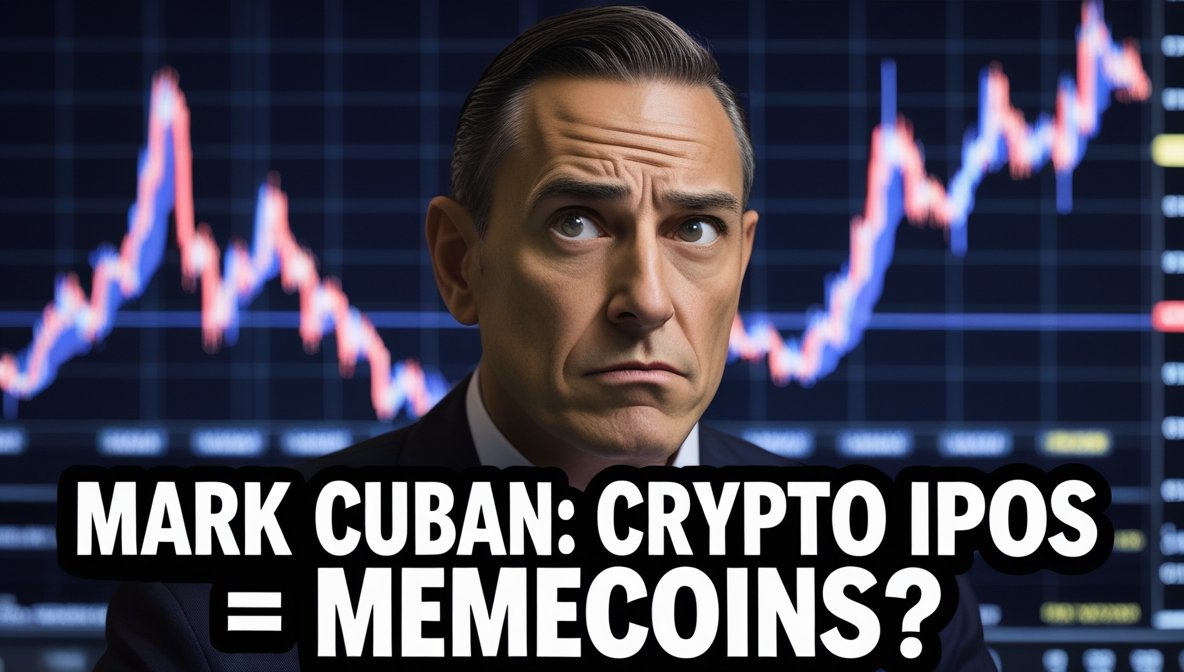
Breaking ! Mark Cuban Warns Crypto IPOs (6% fall), Could End Up Like Memecoins After Bullish Stock Crash

Mark Cuban questions the future of crypto IPOs after Bullish shares plunge 6% post-listing, raising doubts about token-forward IPOs gaining wider trust.

Mark Cuban Questions Future of Crypto IPOs As Bullish Stock Drop

Billionaire investor Mark Cuban is casting doubt on the future of crypto IPOs after shares of Bullish (BLSH) slid more than 6% just a week after going public.

Cuban, who made his fortune during the dot-com boom and owns the Dallas Mavericks, has been a longtime supporter of blockchain projects like Polygon, Aave, and OpenSea. But after watching Bullish stumble during its highly anticipated debut, he took to X with a sharp post: “Will crypto IPOs be treated like a meme coin now?”

Bullish’s public listing was touted as a landmark for token-forward IPOs, which combine traditional stock offerings with digital asset exposure. The idea was to give investors access to web3 without directly holding tokens. But with prices already tumbling, Cuban’s concern highlights a bigger problem: investor sentiment still dominates this market segment.

Future of Crypto IPOs

For many analysts, Bullish’s performance is a warning shot. If volatility continues, future token-linked IPOs could struggle to gain traction with institutional players. Retail-driven swings have already shaken confidence, and Cuban’s cautious tone signals that even strong backers are rethinking the playbook.

For now, the fate of crypto IPOs may hinge on whether companies can prove they offer more than just hype.

YOU MIGHT ALSO LIKE: Hyperliquid Activates Multi-Quote Spot Trading on Mainnet, HYPE Price Sees Whale Buys

Breaking ! MicroStrategy Equity Policy Change Sparks Investor Fury Trust in Saylor at Risk

MicroStrategy equity policy change removing the 2.5x mNAV safeguard has angered investors, raising concerns about dilution and leadership credibility.

MicroStrategy Faces Backlash From Investors Over New Equity Policy

Michael Saylor’s MicroStrategy (NASDAQ: MSTR) is under fire after scrapping its long-standing 2.5x mNAV issuance rule, sparking outrage from shareholders who feel betrayed.

The controversial decision removes a safeguard that prevented the company from issuing stock below 2.5 times its net asset value, a rule designed to protect investors from excessive dilution. Saylor defended the move as necessary to give MicroStrategy greater flexibility amid a shrinking Bitcoin premium, but many argue it represents a broken promise.

Investor Outrage Over MicroStrategy Equity Policy

The harshest criticism came from WhaleWire CEO Jacob King, who accused Saylor of “pulling the rug” and lying to investors. He noted that MicroStrategy’s premium collapsed from 3.4x to 1.6x since late 2024, making the new rule convenient for Saylor’s strategy. Other investors echoed similar frustrations, recalling that Saylor had recently reaffirmed the safeguard during an earnings call just weeks ago.

Industry voices like Adam Simecka and Daan Crypto Trades highlighted the dilution risks and warned that the so-called “Saylor bid” to fund Bitcoin buys via stock issuance could now resume unchecked.

Bigger Risks Ahead

Critics also raised alarms about wider risks: further dilution, falling investor trust, and overexposure to Bitcoin’s volatility. One analyst wrote that the change could “erode long-term shareholder value and put downward pressure on the stock price.”

The backlash ultimately reflects a growing divide: Saylor’s uncompromising Bitcoin-first vision versus shareholder demand for transparency and protection.

YOU MIGHT ALSO LIKE: BlackRock Now Holds 735K Bitcoin Worth $86B, Surpasses Major Crypto Treasuries

Bullish IPO Raises $1.15B in Stablecoins A Historic First for Markets

Bullish IPO raised $1.15B in stablecoins, marking the first public listing settled onchain with USDC, EURC, RLUSD, and more.

Bullish IPO Raises $1.15B in Stablecoins

Bullish (NYSE: BLSH), the digital asset platform backed by billionaire investor Peter Thiel, has raised $1.15 billion from its IPO, with proceeds settled entirely in stablecoins.

The company made its Wall Street debut on August 14, 2025, in one of the year’s most anticipated listings. Demand for shares was huge, with subscriptions 20x oversubscribed, pushing the stock up 84% on day one. However, early volatility followed as the share price dipped 2.16% in pre-market, trading at $62.00 today.

Stablecoins Take Center Stage in Bullish IPO

Bullish said most of the funds were minted on Solana and settled in USDC and EURC, custodied exclusively by Coinbase. Other stablecoins used included SocGen’s CoinVertible series, Paxos’ Global Dollar and PayPal USD, World Liberty’s USD1, Agora Dollar, and AllUnity’s EURAU.

In a notable first, Ripple USD (RLUSD) on the XRP Ledger was also part of the settlement mix. Ripple congratulated Bullish on “the successful IPO,” calling it a milestone for onchain finance.

Why This Matters for Stablecoins

Chief Financial Officer David Bonanno highlighted stablecoins as “one of the most transformative use cases for digital assets,” stressing their role in fast and secure global transfers, particularly on Solana.

By collaborating with multiple issuers, Bullish positioned itself as a pioneer in integrating stablecoins into capital markets, making this IPO the first-ever public listing fully settled onchain.

YOU MIGHT ALSO LIKE: Bhutan Moves $92M in Bitcoin, Still Holds Over $1.15B in BTC

7 Reasons Ethereum: South Korean Investors Are Betting Big on Ethereum Stocks Over Big Tech

South Korean Investors Dump Big Tech for Ethereum Stocks

South Korean retail investors are switching up their portfolios, ditching major U.S. tech names like Tesla, Apple, and Alphabet in favor of Ethereum (ETH)-related stocks — and the numbers show it’s not just a passing trend.

Why BitMine is the Hot Pick

The biggest winner in this shift? BitMine Immersion Technologies (BMNR) — a U.S.-listed firm backed by billionaire Peter Thiel. Once a Bitcoin miner, BitMine now focuses entirely on Ethereum and holds an impressive $5.32B worth of ETH, making it the largest corporate ETH holder in the world. It’s even hinted at issuing up to $20B in stock to buy more ETH.

Since early July, Korean investors have poured roughly $259–269M into BitMine shares, making it Korea’s most popular foreign stock. The buzz is fueled by the recently passed GENIUS Act, which gives stablecoins a clearer legal framework, boosting ETH sentiment. The fact that BitMine’s chairman, Tom Lee, has Korean heritage adds an emotional pull for local buyers.

Other ETH-related stocks are riding the wave too — Robinhood, Coinbase, and SharpLink Gaming (which holds over 728,800 ETH) are all seeing major demand. SharpLink’s stock alone has skyrocketed over 126% since July.

Big Tech on the Chopping Block

Meanwhile, Korean investors are offloading their “Magnificent Seven” holdings — dumping $770M in Tesla shares, $230M in Apple, and $177M in Alphabet last month. High valuations, underwhelming earnings, and uncertainty over U.S. tariffs under President Donald Trump are pushing them away from U.S. tech.

Experts think the Ethereum-stock craze could continue short term, but warn that global economic instability might slow overall foreign stock purchases.

YOU MIGHT ALSO LIKE: 3 Insane Reasons Pump.fun’s $33M Buyback Is Sending PUMP Token Skyrocketing

5 Insane Reasons DeepSeek’s R2 Delay Shows Huawei Chips Aren’t Ready Yet

China’s AI scene just hit a speed bump. DeepSeek, the AI company behind the R1 model that dropped in January, had been hyping its next-gen R2 — but now it’s officially delayed. The reason? Huawei’s chips couldn’t handle the full training process.

Beijing wanted DeepSeek to use Huawei’s Ascend processors instead of Nvidia’s GPUs to cut U.S. tech reliance. Sounds good on paper, but in practice, training R2 on Ascend hit technical walls — instability, slow inter-chip connections, and weaker software compared to Nvidia’s gear.

So, DeepSeek had to pivot: Nvidia chips for training, Huawei chips for inference (the part where AI actually answers questions). This workaround meant pushing the R2 launch from its original May target.

DeepSeek’s Tough Reality Check

Huawei even sent engineers to help make Ascend work, but the model still wouldn’t train properly. On top of that, labeling the massive dataset for R2 took longer than expected. Meanwhile, rivals like Alibaba’s Qwen3 are already shipping powerful new models — and ironically, Qwen3’s training methods borrow ideas from DeepSeek itself.

AI experts say it’s only a matter of time before Chinese chips can compete for training tasks, but for now, U.S. GPUs still rule. Nvidia even struck a deal with the U.S. government to share China profits in exchange for selling its H20 chips there again.

DeepSeek might still drop R2 in the coming weeks, but the delay shows one thing loud and clear — in the AI arms race, hardware bottlenecks can be just as critical as algorithms.

YOU MIGHT ALSO LIKE: U.S. PPI Surges 0.9% in July, Bitcoin Drops Below $119K on Fed Rate Cut Fears

3 Insane Reasons Pump.fun’s $33M Buyback Is Sending PUMP Token Skyrocketing

Pump.fun’s $33M buyback pushes PUMP token up 15% in 24 hours, reinforcing its lead in the Solana memecoin launchpad space.

It just gave the PUMP token community a reason to celebrate. The Solana-based memecoin launchpad has pulled off a massive buyback spree, snapping up $8.42 million worth of PUMP in the past week alone. That’s a huge 97.29% of its weekly revenue — and it’s working. The token price spiked over 15% in 24 hours, trading at $0.004053 according to CoinMarketCap.

This isn’t a one-off move either. Since the program began, Pump.fun has bought back a total of $33.61 million in PUMP, cutting into the circulating supply. That’s roughly 0.741% of its whopping 1 trillion total tokens — and the scarcity effect is real.

Pump.fun’s Memecoin Domination

Pump.fun isn’t just playing defense. On August 11 alone, it launched 26,836 new tokens, grabbing a 73.6% market share of all memecoins created that day, according to Dune Analytics. This puts it way ahead of rivals like LetsBonk and Bags, cementing its position as the go-to platform for memecoin creators on Solana.

Buybacks aren’t new in finance both stock and crypto markets have used them to prop up value for decades. But Pump.fun’s aggressive approach has caught analysts’ eyes, with some saying PUMP could break through higher resistance levels if the momentum holds.

For now, Pump.fun is turning the “memecoin wars” on Solana into its personal victory lap and if they keep this up, PUMP might just be the token to watch in 2025.

YOU MIGHT ALSO LIKE: Safety Shot Teams Up with BONK Memecoin in $25M Token Deal, Stock Plunges 50%

7 Reasons Bullish’s $1.1B NYSE IPO Is a Massive Win for Crypto

Bullish raises $1.1B in its NYSE debut, securing a $5.4B valuation and strong institutional backing as crypto IPO momentum accelerates.

Bullish just dropped a huge announcement their New York Stock Exchange debut pulled in a massive $1.1 billion after pricing 30 million shares at $37, well above the original $32–$33 target range. That pricing move gives them a $5.4 billion valuation and puts them officially on the NYSE under ticker BLSH starting August 13, 2025.

The IPO wasn’t just good, it blew past expectations. Earlier this week, Bullish aimed for $990 million, but investor demand was so strong that they smashed through that goal during final pricing. Institutional giants like BlackRock and ARK Invest are already in for up to $200 million worth of shares, and big banks JPMorgan, Jefferies, Citigroup — led the underwriting.

Why Bullish’s NYSE Leap Matters

This isn’t just about raising cash it’s about staking a claim in the growing list of publicly traded crypto companies. Bullish had a failed SPAC attempt back in 2022, but this comeback move, starting with a confidential SEC filing in June and a public registration in July, shows they’ve been playing the long game.

The IPO also reflects a major vibe shift in U.S. crypto markets. Pro-crypto policies under the Trump administration, like the recently signed GENIUS Act, and a rebound in digital asset prices have created perfect conditions for companies like Bullish to step into the spotlight.

With this raise, Bullish now has the fuel to expand its exchange platform and possibly set a benchmark for future crypto IPOs in the U.S.

YOU MIGHT ALSO LIKE: Safety Shot Teams Up with BONK Memecoin in $25M Token Deal, Stock Plunges 50%

Exit mobile version