SEC to Evaluate NYSE’s Proposal for Grayscale’s Ethereum ETF Staking

NYSE wants SEC approval for Grayscale’s Ethereum ETF to stake holdings, boosting returns without extra risks, pending regulatory decision.

The New York Stock Exchange (NYSE) is pushing to let Grayscale’s Ethereum ETFs stake their Ether holdings and earn rewards. If the U.S. SEC approves this move, it could change the game for Ethereum-based ETFs.

Grayscale’s Ethereum Trust ETF (ETHE) and Ethereum Mini Trust ETF (ETH) would stake their Ether, possibly boosting returns for investors while keeping the funds efficient. The proposal, filed on Feb. 14, aims to make Ethereum ETFs more competitive by adding staking rewards.

Grayscale made it clear that staking will bring extra income, but they’re not promising fixed returns. They also clarified that this doesn’t involve “delegated staking” or “staking as a service.” Investors would still be exposed to Ethereum price changes but could earn extra rewards on top.

This move follows similar plans by 21Shares, who recently tried to add staking to its Ethereum ETF. While the SEC initially blocked Ethereum ETF staking in 2024 over regulatory concerns, with a new, potentially crypto-friendly SEC, things could change.

If approved, Grayscale’s ETFs could generate passive income through staking, adding more value for investors while tracking Ethereum’s price. The decision could be a big step in how crypto ETFs evolve.

Also Read: Near Protocol Ex-Employee Accidentally Leaks Nudes on Livestream, Apologizes to Girlfriend


Ethereum Foundation Moves 45,000 ETH to DeFi Instead of Selling

Summary: Breaking abruptly from its previous policy, the Ethereum Foundation (EF) has sent 45,000 ETH to the leading DeFi platforms. Rather than selling it outright, the action is meant to support the DeFi community without having any impact on Ethereum’s market stability.

The Ethereum Foundation has allocated 10,000 ETH to Spark, 10,000 ETH to Aave Prime, 20,800 ETH to Aave Core, and 4,200 ETH to Compound Finance. In total, this amounts to roughly $117.62 million based on today’s ETH price of $2,613.68.

YOU MIGHT ALSO LIKE: PancakeSwap’s CAKE Surges 60% – Here’s What’s Fueling the Rally

The decision comes following strong criticism from the community after the foundation sold 4,000 ETH straight out in January of this year. The majority grumbled that this sale would negatively impact the price of Ethereum and render the market unstable.

By putting money into DeFi early, EF is betting on decentralized finance and ongoing to gain a return without tampering with market volatility. This also helps the liquidity of protocols like Aave and Compound, which works to perpetuate the DeFi ecosystem.

YOU MIGHT ALSO LIKE: XRP Eyes $8 Amid ETF Approval Hype – Will It Finally Break Out?

The move has been embraced by the Ethereum community because it is consistent with a model of sustainability of managing the treasury of the foundation. Instead of selling ETH in exchange for cash, EF is now effectively investing in the ecosystem that it founded, thus demonstrating its commitment to long-term Ethereum building and construction.

Spiko Introduces Tokenized T-Bills on Etherlink Layer 2

Spiko drops tokenized T-Bills on Etherlink, bringing secure, yield-bearing USD & Euro savings to DeFi. Launch set for February!

Paris-based fintech Spiko is shaking up DeFi by launching tokenized U.S. and E.U. T-Bills on Etherlink, a blazing-fast Layer 2 blockchain on Tezos. This move lets users hold yield-generating assets in self-custodial wallets, giving them secure savings in both USD and Euro—a first in the space.

Spiko is no small player. With $165M+ in assets, their tokenized funds, USTBL and EUTBL, rank among the top real-world assets (RWAs) in crypto. Etherlink’s ultra-low fees, sub-second transactions, and censorship resistance make it the perfect platform for expanding DeFi’s reach. The network already integrates with big names like Arbitrum, Starknet, and Polygon PoS.

Spiko’s CEO Paul-Adrien Hyppolite believes finance should be digital, open, and composable, bridging the gap between traditional markets and blockchain. Unlike most DeFi products, Spiko’s funds follow strict European UCITS regulations, ensuring top-tier security and transparency.

Etherlink is rapidly becoming a leading DeFi hub, welcomed projects such as uranium.io (the first ever uranium marketplace online) and a.etherlink domain service. As Spiko goes live in February, Etherlink is demonstrating that Tezos L2 is here to stay.

Also Read: HTX Delists PI Coin and Suspends Trading Before Mainnet Launch

World Liberty Financial Snaps Up $5M in ETH During Market Dip

According to blockchain analytics firm Spot On Chain, the Trump-backed DeFi project, World Liberty Financial (WLFI), just scooped up another 1,917 ETH—worth around $5 million—on February 11.

On-chain data reveals that this latest move pushes WLFI’s total portfolio to a whopping $96.72 million, with over $48 million in ETH alone. In spite of market being volatile, WLFI is still stacking ETH and showcasing a strong and long term confidence and belief in Ethereum’s future.

YOU MIGHT ALSO LIKE: XRP Stuck at $2.5—When Will It Break Out?

Since the start of the year, WLFI has been aggressively accumulating ETH and other crypto assets, now holding a total of 18,549 ETH valued at $48.7 million. This strategy of consistently buying does give a hint of a potential bullish outlook on Ethereum, even of the price is fluctuating. WLFI also announced “Macro Strategy” today its new strategic token reserve aimed at strengthening its foothold in the crypto world.

YOU MIGHT ALSO LIKE: TRON Just Hit 125M Users—What Does It Mean for TRX?

“This steady accumulation from WLFI is great for ETH in the long run. If other institutional investors jump in, we could see Ethereum cross $4,000 soon,” a top crypto analyst shared.

Ethereum is already a hot topic, thanks to increased gas limits, the upcoming Pectra upgrade, and growing debates around leadership changes in the Ethereum Foundation.

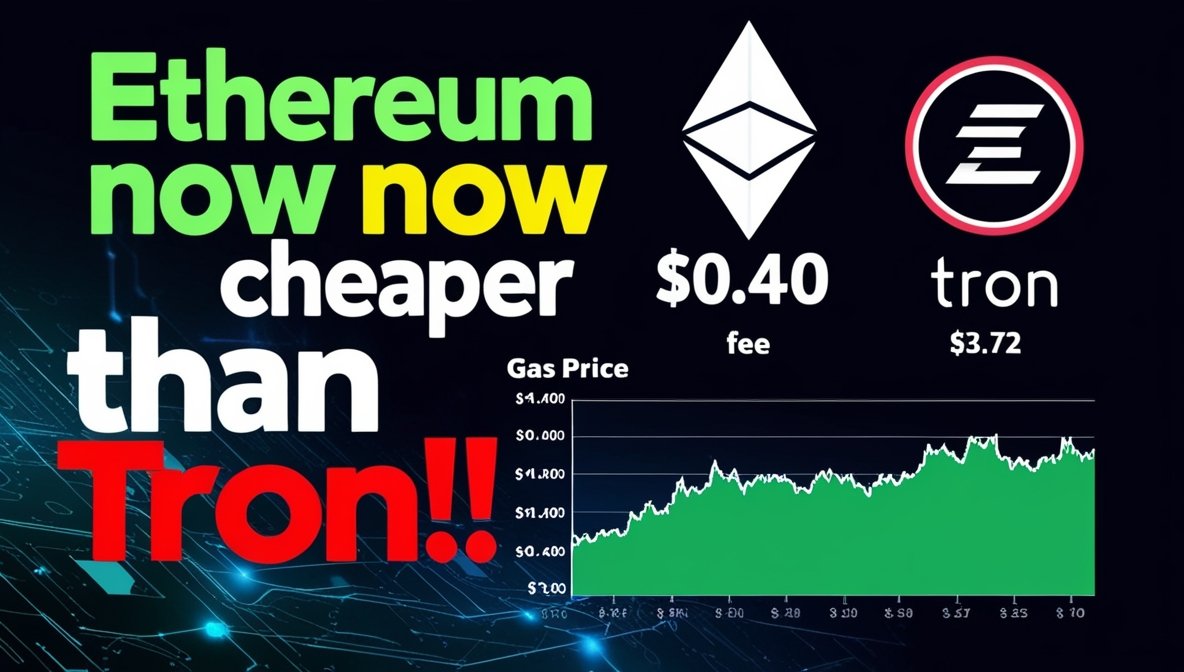
USDT Transfers on Ethereum Become Cheaper Than on Tron

USDT transfers are now cheaper on Ethereum ($0.40) than Tron ($3.72), thanks to Ethereum’s low gas fees.

In a surprising twist, USDT transfers are now cheaper on Ethereum than on Tron. Ethereum’s gas fees have dropped to their lowest level in five years, making it a more affordable option than Tron, which was once known for having the lowest transaction fees in the blockchain world.

For example, transferring USDT from Trust Wallet costs just $0.40 on Ethereum, in comparison to $3.72 on Tron. This is a huge shift, considering it was once one of the most expensive blockchains to use due. At one point, users were paying as much as $198 per transaction on Ethereum! But now, the average gas price on Ethereum has dropped to a super-low $0.05 per transaction.

While Tron has been dominant in fee generation recently, Ethereum’s price drop could signal a shift in the DeFi ecosystem. Solana is currently leading the pack in 24-hour fee generation, with Tron and Ethereum following behind.

With gas fees now much cheaper, experts believe that Ethereum’s DeFi ecosystem could see a major recovery in the coming months, gaining back the traction it lost due to high transaction costs.

Also Read: Elon Musk’s ‘Harry Bolz’ Name Change Sparks Over 200 New Memecoins

ETH Supply Rises Back to Pre-Merge Levels

ETH supply just bounced back to pre-Merge levels, thanks to blob transactions from the Dencun upgrade, reducing ETH burns and increasing inflation.


Ethereum’s supply just shot back up to where it was before the Merge, all thanks to a surge in blob transactions. According to UltraSound.Money, ETH’s circulating supply now sits at 120,521,600, wiping out the deflationary impact the Merge once had.

Before the Dencun upgrade, Ethereum’s fee-burning system kept supply in check—users paid gas fees, and a chunk of that ETH was burned, reducing overall supply. But now, blob transactions, designed to handle massive data loads for layer 2 networks, don’t burn fees, meaning less ETH is removed from circulation. With blob transactions booming, ETH inflation is creeping up again.

Things could get even crazier with the upcoming Pectra upgrade, which plans to increase both the blob target and max limit. This would mean even more ETH flooding the market.

From supply to large-scale structural changes, Ethereum is changing big time. Just very recently, the gas limit jumped to 36 million, accommodating more transactions in each block. Furthermore, even Vitalik Buterin himself has gotten directly involved in restructuring the team at the Ethereum Foundation.

As these steps keep jolting the network, predictions regarding the future dynamics of ETH’s supply become increasingly difficult.

Also Read: Has the Hawk Tuah Girl Been Arrested for Her Memecoin? Here’s the Truth

Ethereum Community Backs Danny Ryan for Foundation Leadership

Ethereum holders voted overwhelmingly for Danny Ryan as Ethereum Foundation leader, sparking leadership debates despite Vitalik Buterin’s call for structured reforms.


An informal on-chain vote at votedannyryan.com has shown massive community support for Danny Ryan as the next leader of the Ethereum Foundation. A total of 296 ETH holders, collectively controlling over 50,000 ETH, participated in the gas-free vote using their wallets. An overwhelming 279 votes—about 99%—favored Ryan.

Danny Ryan, one of the key researchers behind the recent Ethereum Merge into proof-of-stake consensus from proof-of-work consensus, saw overwhelming community support. The poll was led by Ethereum contributor Fabrice Cheng in a claim for greater community involvement in the foundation’s leadership. A number of voters argued that the foundation was managed inefficiently and that the expertise of Ryan would better position Ethereum toward its long-term vision.

Ethereum co-founder Joseph Lubin has also thrown his weight behind Ryan for his energy and deep technical knowledge. But it’s an informal vote, with no mandate for change. In the other camp was Vitalik Buterin calling for patience – although more for the structured governance reforms before any transition in leadership.

Ryan himself has shown interest for the post and has revealed conversations with Buterin and other members of the foundation. But while the vote is unofficial, it does indicate building consensus within the Ethereum community for change at the top.

Also Read: Netflix Faces Legal Heat Over Razzlekhan Crypto Heist Doc

Vitalik Buterin Wants Layer 2s to Boost Ethereum’s Game with ETH

Summary: Vitalik Buterin, OG co-founder of Ethereum, called Layer 2 networks to go all in with ETH big time. Here are hot takes on how Ethereum scaling goes from meh to massive, and ETH becomes the MVP.

Scaling on Ethereum has been slow, but the CEO V Vitalik Buterin had a plan how to get things pop. He encourages Layer 2 solutions to make ETH their go-to asset-be it for staking, burning, or collateral. Goal: Make ETH skyrocket in value and Ethereum the backbone of a thriving blockchain economy.

YOU MIGHT ALSO LIKE: AI Tech Helps Indian Police Reunite Lost Families at MahaKumbh

Vitalik’s spicy take: L2 networks should burn or stake some of their gas fees permanently to keep ETH at the center. And he’s hyped about blob transactions too—yes, blobs. If blob fees stay steady and the blob count jumps to 128, Ethereum could burn 713,000 ETH annually. Translation: Big bucks for the network.

The blog also drops hints about leadership changes at the Ethereum Foundation, showing Vitalik’s ready to shake things up. “Ethereum’s tech and community are leveling up, but there’s still tons to do. Now’s the time to double down,” he says.

YOU MIGHT ALSO LIKE: Vine Founder’s VINE Coin Smashes $200M Market Cap in Hours

Vitalik’s vibe is clear: L2s and ETH are the power couple that can take Ethereum from good to god-tier. Time to lock it in, blockchain fam.

Ethereum Shake-Up: Developer Exits as Vitalik Reshapes EF Leadership

OG Ethereum dev Eric Conner dips after EF leadership shake-up, joins FreysaAI to safeguard crypto prize pools with AI.


Big changes are hitting the Ethereum world. Eric Conner, one of the real OGs of Ethereum development, just announced he’s leaving the community. This comes right after Vitalik Buterin dropped news about reshuffling the Ethereum Foundation (EF) leadership.

Eric’s been in the game for over a decade, making waves in Ethereum’s DeFi scene. His standout work is basically co-authoring EIP-1559, the game-changing upgrade that revamped how transaction fees work. Pretty legendary stuff.

In an X post, Eric shared how Vitalik’s early pitch for Ethereum hit him harder than Bitcoin ever did. But now? The vibe’s different. Eric’s passion for Ethereum faded as the EF’s upper management shifted directions. He felt like the connection between the community and leadership got blurry after Vitalik stepped back.

“I respected Vitalik as a genius and a solid leader,” Eric said. “But with him taking a step back, EF just didn’t feel the same.”

So, what’s next for Eric? He’s diving into the AI world, joining FreysaAI—a project on the Base blockchain. Their mission? Using AI agents to protect crypto prize pools. A fresh chapter for a DevFi legend.

World Liberty Financial Transfers $61.4M in Ethereum

Crypto project World Liberty Financial, which has connections with President-elect Donald Trump, has moved approximately $61.4 mln worth of Ethereum within the last 24 hours, says Arkham Intelligence in a tweet. The cash moved between different wallets, one of which is Coinbase Prime.

“These are regular movements of our crypto holdings for treasury management, covering fees, expenses, and working capital needs,” explained WLFI in an X post. It said no tokens were sold during those transactions, referring to the action as standard practice.

YOU MIGHT ALSO LIKE: ANIME Token Unveils Community-Focused Tokenomics

Data on the blockchain shows more transactions, which include the transfer of 103 WBTC for 3,075 ETH, valued at $10 million; the transfer of another $59.8 million in Ethereum to Coinbase Prime and other wallets. WLFI also spent $1.7 million in Tether (USDT) to buy 17.62 WBTC at an average price of $96,490.

WLFI’s wallet, once holding $83 million in mid-December, now has a balance of $17 million. Despite this drop, WLFI maintains a long-term investment strategy, with $4.8 million in unrealized losses due to market fluctuations in assets like Ethereum, WBTC, Aave (AAVE), and Chainlink (LINK).

YOU MIGHT ALSO LIKE: Crypto Market Surges Following US CPI Data Release: What Lies Ahead?

In parallel, WLFI has partnered with Ethena Labs to integrate the sUSDe stablecoin into Aave, showcasing its efforts to expand its ecosystem despite the volatility.

Exit mobile version