Circle ($CRCL) Rings the NYSE Bell: USDC Issuer Goes Public, Crypto Meets Wall Street
Circle, the firm behind the USDC stablecoin, has officially become a public company. Trading under the ticker $CRCL on the New York Stock Exchange (NYSE), Circle’s public debut signals a pivotal shift in the world of digital finance.
Known for more than just USDC, It also offers EURC and a Payments Network aimed at building seamless, borderless transactions. The company positions itself as more than a fintech innovator — it’s “building the money layer of the internet,” a vision now fueled by Wall Street support.
The move drew excitement across crypto Twitter. Lulo, creator of the Stablecoin Savings App, tweeted:
“INTERNET FINANCIAL MARKETS COMING TO MAINSTREAM.”
Meanwhile, venture capitalists praised it for trailblazing:
“Exciting times ahead! Circle is setting the stage for a new era in finance.”
Its entry into public markets isn’t just a financial milestone — it’s a statement of intent. The future of money is programmable, digital, and now… publicly traded.
SOL has emerged as a leading cryptocurrency in 2025, known for its high-speed transactions and scalability. With major banks like HSBC and Bank of America integrating Solana’s blockchain through partnerships with R3, institutional adoption is at an all-time high. Analysts predict that Solana’s price could reach between $500 and $1,000 by the end of the year, driven by its growing presence in decentralized finance (DeFi) and non-fungible tokens (NFTs).
In 2025, SOL’s integration into traditional finance has accelerated. Major financial institutions, including HSBC and the Monetary Authority of Singapore, are adopting Solana’s blockchain for tokenizing assets like stocks and bonds. This move signifies a strategic shift towards public blockchains, with SOL offering greater scalability and lower transaction costs compared to competitors.
The Road Ahead
Looking forward, SOL’S trajectory appears promising. With the potential approval of SOL-based exchange-traded funds (ETFs) and continued institutional interest, the cryptocurrency is poised for significant growth. Analysts remain optimistic, citing it’s technological advancements and expanding ecosystem as key drivers for its future success.
ETH isn’t just another cryptocurrency; it’s the backbone of the decentralized internet. Launched in 2015 by Vitalik Buterin and others, Ethereum introduced smart contracts and decentralized applications (dApps), revolutionizing how we interact online. Its native token, Ether (ETH), fuels this ecosystem, enabling everything from DeFi platforms to NFTs.
The Merge: ETH’s Green Revolution
In September 2022, Ethereum transitioned from Proof-of-Work to Proof-of-Stake, a move dubbed “The Merge.” This shift reduced the network’s energy consumption by over 99%, addressing environmental concerns and enhancing scalability.
As of March 2025, Ethereum’s market cap stands at approximately $237 billion, reflecting its significant role in the crypto market.
ETHs Expanding Universe
Ethereum’s versatility is evident in its wide range of applications:
DeFi Platforms: Powering decentralized finance applications that offer lending, borrowing, and trading without intermediaries.
NFT Marketplaces: Hosting platforms for creating and trading non-fungible tokens, representing unique digital assets.
Decentralized Exchanges (DEXs): Facilitating peer-to-peer cryptocurrency trading without centralized authorities.
Tokenization of Assets: Enabling the representation of real-world assets like real estate and stocks on the blockchain.
Supply Chain Management: Improving transparency and traceability in product supply chains.
Decentralized Identity Solutions: Allowing users to control their digital identities securely.
Healthcare Applications: Enhancing patient data management while maintaining privacy and security.
The Road Ahead
Industry experts predict a bullish future for ETH. Standard Chartered Bank forecasts ETH reaching $14,000 by the end of 2025, citing factors like the approval of spot Ether ETFs and network upgrades enhancing scalability. Similarly, Nasdaq analysts anticipate Ethereum’s market cap hitting $1 trillion, driven by increased institutional adoption and the growth of decentralized applications.
Ripple’s Vision Grows: CTO David Schwartz Talks XRPL, Beyond Just Crypto Payments
Ripple’s CTO, David Schwartz, just gave a powerful update that shifts how we should think about XRP and the XRP Ledger (XRPL). In his latest post, Schwartz shared that XRPL isn’t just another crypto payment platform. It’s shaping up to be a complete decentralized financial system.
This system will include more than just XRP — it’s being built to support its stablecoin RLUSD, real-world tokenized assets, decentralized exchanges (DEXs), lending, investing, and even smart contracts.
Schwartz pointed out that for a DEX to thrive, it needs more than one token — which is why XRPL is expanding to support a variety of assets. Still, XRP remains key: it’s the native asset, used for fees and liquidity routing.
He also raised a tough question: how much of XRP’s market value today is driven by actual use on the ledger? Ripple is watching this closely as they build for a more open, faster, and efficient financial future.
Bottom line: Ripple isn’t building just for crypto anymore — they’re going after the entire financial stack.
Pump.fun May Drop Token Soon With $1B Raise at $4B Valuation — Airdrop Rumors Flying
Pump.fun might just be prepping the biggest meme coin power move of the year. According to unnamed sources speaking to Blockworks, the Solana-based meme coin launcher could soon raise $1 billion in a token sale — valuing the project at a jaw-dropping $4 billion.
That would instantly place Pump.fun among the top 30 crypto tokens by market cap, according to NYC-based entrepreneur Nick O’Neil. Wild, right?
🤫 But… Didn’t They Deny It?
Yup. Earlier this year, co-founder Alon Cohen played it cool on X, brushing off token launch rumors and telling users to ignore speculation.
“I would advise not to listen to anything that didn’t directly come from Pump.fun,” he said, while hinting that users would be rewarded “properly.”
So… maybe an airdrop is on the way? 👀
Community Speculates: Token Drop in 2 Weeks?
While Blockworks didn’t confirm launch timing, X is buzzing with claims that the token drop could happen within the next two weeks, potentially followed by an airdrop for early users.
🔥 “If you’ve used Pump.fun, you might wanna keep an eye out,” said one Solana-based alpha caller.
From Meme Chaos to $700M Revenue
Launched in January 2024, Pump.fun became the go-to plug for launching viral meme coins on Solana — making it easy for anyone to spin up tokens in minutes. Since then, it has reportedly pulled in over $700 million in revenue, despite controversies.
Yep, the journey hasn’t been drama-free.
👮♂️ Cease & desist letters were issued over 200+ IP-infringing meme coins.
📉 Even dark moments hit the platform’s livestreams.
Still, the project has remained resilient — and massively profitable.
💬 Nick O’Neil: “This Could Be Huge”
“At a $4 billion valuation, Pump.fun would be one of the top 30 crypto tokens. This is going to drive a ton of liquidity and raise serious capital,” said Nick O’Neil on X.
📉 Solana’s Price Reacts (But Then Recovers)
SOL jumped 7% earlier this week, breaking above $159.
But it dipped 2% following the Pump.fun news — likely from short-term market jitters.
SOL has since recovered half the drop, currently trading at $156.50 with a $81.74B market cap.
Some are saying this is just the start of a fresh bullish wave for Solana’s ecosystem — and Pump.fun might be the fuel.
Bitcoin Supply Shock Incoming: Only 146K BTC Left in OTC as Institutions Pile In
The Bitcoin game just changed — hard. According to Sygnum Bank’s June 2025 Investment Outlook, BTC’s liquid supply has dropped 30% in the last 18 months, setting up a massive supply shock that could fuel explosive price action.
1M BTC Gone Off Exchanges = Bullish Signal?
Over 1 million Bitcoin have quietly vanished from exchanges — a classic bullish indicator. Why? When BTC leaves exchanges, it’s usually headed for cold storage or long-term holding. That means less available supply, especially just as institutional demand is heating up.
“Its fast-shrinking liquid supply is creating the conditions for demand shocks and upside volatility.” — Sygnum Bank
Institutions, ETFs & States Are Hoarding BTC
Here’s the real kicker: institutions aren’t just dipping their toes in anymore — they’re diving in. ETFs, trusts, and corporate portfolios are pouring fresh capital into BTC, giving investors a new way to get exposure without holding the actual crypto.
And it’s not just Wall Street.
Three US states (including New Hampshire) now have reserve laws.
Texas could be next.
Even Pakistan and Reform UK (yes, the political party leading UK polls) are eyeing national BTC reserves.
Only ~146K BTC Left in OTC Desks
According to Bitcoin analyst Carl ₿ Menger, OTC desks — where big buyers scoop up BTC without hitting the public market — are nearly tapped out:
“BREAKING: SUPPLY SHOCK IS REAL — only ~146K #Bitcoin left in OTC markets. Major institutional buys will soon hit public exchanges. Buckle UP.” – @CarlBMenger
That’s a big deal. Once OTC liquidity dries up, institutions have to buy from public exchanges, driving up prices in real time.
BTC Volatility Now Tilting Bullish
Interestingly, Sygnum notes that Bitcoin’s upside volatility has now outpaced downside for three years straight. Translation? The dips are shallower, and the pumps are stronger — a sign of market maturity and deeper liquidity.
Meanwhile in Fiat Land…
Coinbase CEO Brian Armstrong dropped a truth bomb this week, warning that Bitcoin could replace the US dollar as global reserve currency if America doesn’t fix its $37 trillion debt problem.
“I love Bitcoin, but a strong America is also super important for the world,” Armstrong said on X. “We need to get our finances under control.”
The Paris-listed Blockchain Group has ramped up its Bitcoin accumulation strategy with a $68.6 million purchase of 624 BTC, marking its largest single-day acquisition to date. This brings the company’s total BTC holdings to 1,437—currently valued at approximately $150.37 million.
This latest buy was funded through a $63 million convertible bond deal with Fulgur Ventures, resulting in 544 BTC acquired. An additional 80 BTC came from a $9.8 million capital raise in late May.
The transactions were executed via Banque Delubac & Cie and Swissquote Bank Europe, with custody handled by Swiss blockchain infrastructure firm Taurus.
Blockchain Group began its BTC accumulation journey with smaller buys in late 2024, including 15 BTC in November and 25 BTC in December. The group gradually ramped up its purchases, acquiring 580 BTC in March and 227 BTC in May before this week’s substantial addition.
As of May 31, the firm has recorded an unrealized gain of $47.88 million on its Bitcoin portfolio.
The aggressive accumulation aligns with the company’s long-term treasury strategy of increasing Bitcoin holdings per share. Backed by recent capital raises, Blockchain Group sees Bitcoin as a core treasury asset—positioning itself among the growing cohort of institutional holders betting on BTC’s long-term upside.
On June 3, 2025, Ethereum (ETH) demonstrated significant strength in the cryptocurrency market, registering a 5% increase in value to reach $2,616. This surge is attributed to heightened institutional buying, signaling growing confidence in Ethereum’s long-term potential.
Ethereum leads the crypto market with a 5% gain
In contrast, Bitcoin (BTC) maintained a steady position above the $105,000 mark, trading at $105,452 with a modest 0.6% uptick over the past 24 hours. While Bitcoin’s stability is noteworthy, Ethereum’s outperformance highlights its increasing appeal to institutional investors.
The broader cryptocurrency market also reflected positive sentiment, with major altcoins such as Solana, XRP, Dogecoin, and Cardano experiencing gains ranging from 1.5% to 3%. This overall upward trend suggests a renewed investor interest across various digital assets.
Ethereum’s recent price movement underscores its growing prominence in the crypto ecosystem, particularly as institutional entities seek diversified exposure beyond Bitcoin. Analysts suggest that if this trend continues, Ethereum could solidify its position as a leading asset in the digital currency space.
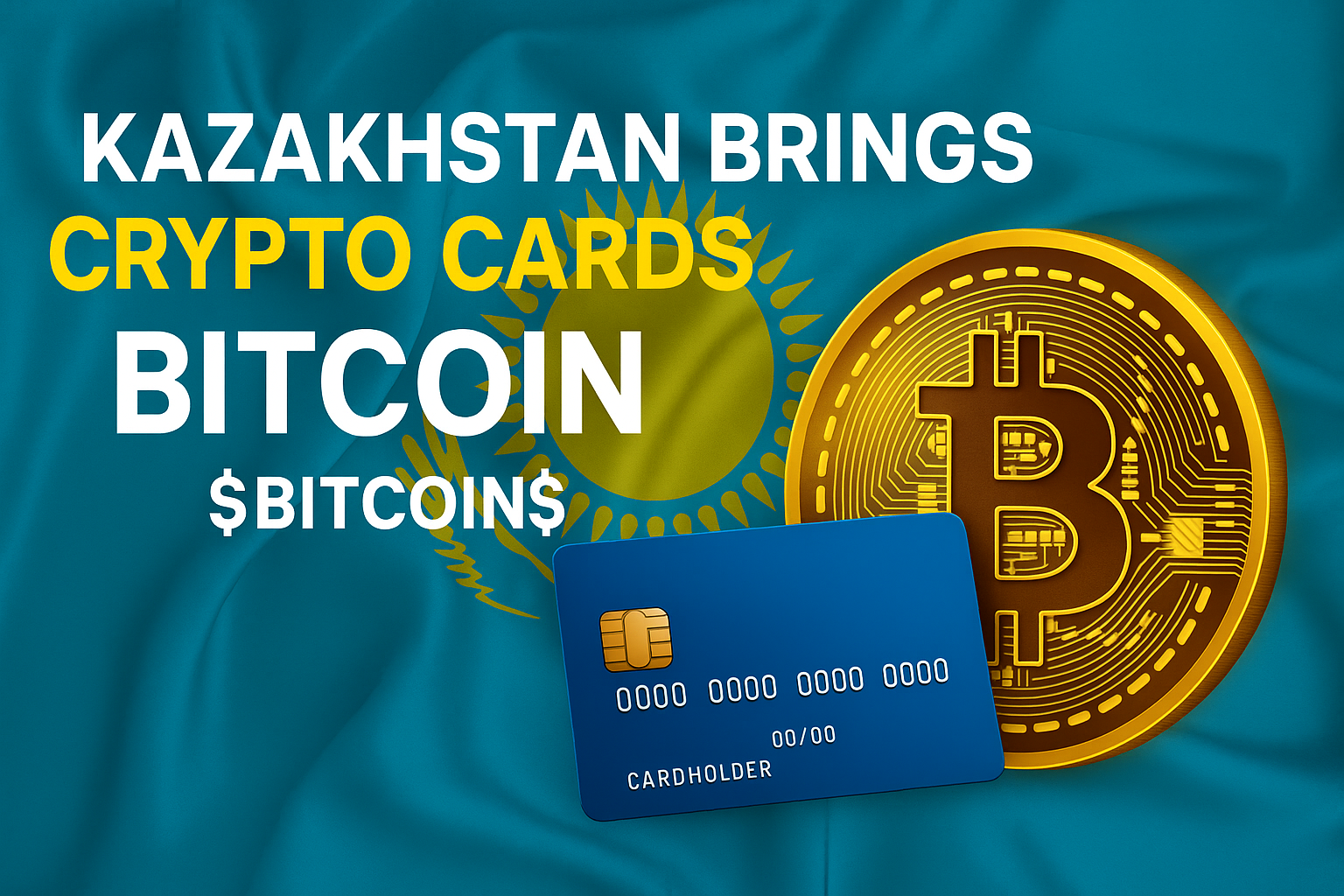
Kazakhstan is moving forward with Bitcoin-powered innovation as the country rolls out cryptocurrency-linked payment cards, making digital assets like Bitcoin usable for daily purchases. These cards will connect to wallets held at regulated crypto platforms under the Astana International Financial Centre (AIFC).
Kazakhstan to introduce Bitcoin-based crypto cards.
The initiative was introduced during a high-level meeting between the National Bank of Kazakhstan, local banks, cryptocurrency exchanges, and fintech firms. The aim is to integrate Bitcoin into everyday life while maintaining compliance and security.
The new payment process is designed to be seamless. When a user makes a purchase using the crypto card, the selected cryptocurrency—such as Bitcoin—is instantly converted into Kazakhstan’s national currency. The funds are then transferred to the card in real time, enabling payment in fiat while preserving the user experience of spending crypto.
This real-time crypto-to-fiat conversion is possible thanks to deep cooperation between Kazakhstan’s banks and licensed crypto providers operating under the AIFC.
In addition to the crypto card program, Kazakhstan’s central bank is pushing several other digital finance initiatives. These include the development of a national currency-backed stablecoin, the tokenization of real-world assets like property, and the implementation of secure systems for storing digital financial instruments.
The country is also building infrastructure for easier cryptocurrency storage and exchange, aiming to encourage innovation and digital transformation within its financial sector.
With the launch of these Bitcoin-based crypto cards and a broader embrace of blockchain technology, Kazakhstan positions itself as a growing hub for regulated crypto-financial services.
On June 3, 2025, Ripple’s RLUSD stablecoin achieved a regulatory breakthrough by securing approvals from both Dubai’s Financial Services Authority (DFSA) and New York’s Department of Financial Services (NYDFS). This rare dual-certification positions RLUSD as a serious player in the $160 billion stablecoin market.
Backed 1:1 by U.S. dollar reserves and subject to institutional-grade audits, RLUSD meets the compliance standards of both regions. With this move, Ripple is doubling down on its global payments strategy—especially in the Middle East, where partnerships with banks like Zand and fintech platforms such as Mamo are already in motion.
This development aligns with Dubai’s ambitions to become a global crypto hub. In fact, stablecoin usage in the UAE jumped 55% in 2024 alone, according to Chainalysis. Ripple’s entry into the DIFC—a major financial zone housing 7,000+ firms—could accelerate blockchain adoption in areas like cross-border payments and even property management, thanks to Ripple’s pilot project with the Dubai Land Department.
As competitors like Circle’s USDC and Tether race to expand in the region, Ripple’s dual-regulatory win sets a new benchmark. RLUSD isn’t just compliant—it’s operationally ready for real-world utility.