Ethereum Dips Under $3000: What’s Driving the Slide?

ETH tanked to $2991 amid rising U.S. bond yields, inflation fears, and whale dominance, leaving traders worried about recovery vibes.


Ethereum (ETH) just got absolutely wrecked. It somehow managed to drop by 8% to $2991 before clawing back to $3017. Traders are trolling, “Is recovery even a thing now?”

The chaos started last Friday when unexpected U.S. interest rate data hit, sparking inflation fears. The Fed might not cut rates anytime soon, so crypto investors are feeling the squeeze. Plus, the U.S. job market added 256K jobs instead of the expected 160K, signaling a strong economy. While that’s great for traditional markets, it sent U.S. bond yields soaring, making risky investments like crypto way less attractive.

Ethereum’s been in a slump, falling from $3332 to $3196, and hasn’t stopped sliding. Analysts like Ali Martinez say resistance is heavy between $3360-$3450, with support hanging at $3066-$3160. Fun fact: three whale wallets control 43% of ETH’s supply, so they’re probably low-key steering the ship.

Meanwhile, whales are still stacking ETH. One just pulled 10K ETH (around $30.7M) from Binance, while large transactions spiked 70%. But with ETH supply creeping back to pre-merge levels and tight liquidity everywhere, ETH’s struggles are real.

TL;DR: Bond yields and whale games got ETH on thin ice. Will it bounce back, or is this the start of another dip?

Also Read: TON Blockchain Eyes US Growth Amid Trump Administration Policies

Singapore Blocks Polymarket: A Tough Stand on Crypto Betting

Singapore has banned Polymarket, a decentralized crypto prediction platform, due to strict gambling laws. Allowing users to create and bet on real-world events using cryptocurrency, it failed to obtain a license from the government to legally operate in the city-state.

Singapore’s Remote Gambling Act, since 2014, has only permitted certain state-approved betting activities: things like lotteries and sports gambling. Sites like Polymarket, operating outside the ambit of such regulation, are banned without hesitation. The government has now officially blocked access to the site, effective January 11.

YOU MIGHT ALSO LIKE: Bitcoin Crash Wipes $138B, $520M Liquidated in 24 Hours

This is not the first time such regulatory hurdles have had to be faced by Polymarket. Recently, it settled with the Commodity Futures Trading Commission in the United States that had been clamping down on several unregulated DeFi platforms. CFTC Chair Rostin Behnam said that they were very much focused on digital asset platforms falling within the legal ambit.

Its struggles are not singular, however. China, along with several European and Asian countries, has come down hard on online gambling or crypto gaming platforms. Without centralized regulation, such sites sometimes find it tough to call the legal line in jurisdictions where strict controls are in place.

YOU MIGHT ALSO LIKE: Solana’s Gas Fees Overtake Ethereum’s in the Past Week

As governments around the world continue to turn the screws on DeFi, sites like Polymarket are increasingly finding it tough to expand.

Bitcoin Crash Wipes $138B, $520M Liquidated in 24 Hours

It came with huge selling, along with liquidations, when Bitcoin-the king of cryptocurrencies-plunged about 3% within four hours on the second day in a row. The result is being witnessed in the falling price of Bitcoin to $91,644.04, washing away about $138 billion of valuation from the market within a few hours.

Combined liquidations over the last 24 hours have reached an eye-watering $520 million, with long positions taking the brunt of this at $450 million and shorts at $66.06 million. In the last 12 hours alone, total liquidation amounts to $420 million. The single biggest loss occurred on Binance, where a BTC/USDT position worth $8.21 million was liquidated.

YOU MIGHT ALSO LIKE: Indian Railways to Launch NFT Tickets for MahaKumbh Pilgrimage

This drop follows Bitcoin’s recent gains and reflects a sharp market correction, catching many traders off guard. With nearly 197,007 traders across exchanges liquidated, the turbulence serves as a stark reminder of the crypto market’s notorious volatility, where fortunes can evaporate in the blink of an eye.

YOU MIGHT ALSO LIKE: Twin Protocol Debuts $TWIN Token on BitMart Exchange

While the market struggles to stabilize, most investors are now stepping back, trying to figure out whether this is just a temporary correction or the start of a greater decline. All eyes, for the time being, rest on the next move of Bitcoin, as the entire market holds its breath.

Solana’s Gas Fees Overtake Ethereum’s in the Past Week

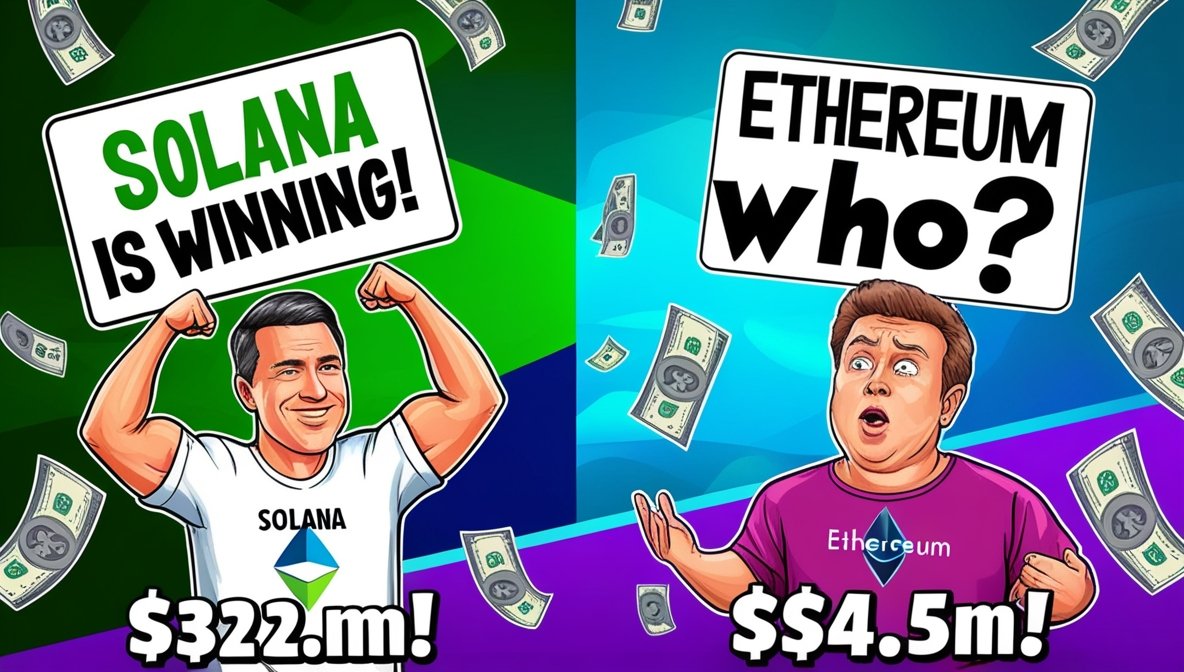
Solana’s gas fees hit $32.2M, surpassing Ethereum, driven by rising transactions, memecoin trading, and DEX usage.

Solana has been making big moves lately. Just recently it surpassed Ethereum in gas fees. Nansen CEO Alex Svanevik recently shared that Solana brought in around $32.2 million in fees, while Ethereum made $25.5 million. This shows Solana’s growing popularity and potential to compete with Ethereum.

So, what’s behind this spike? Well, Solana’s been processing more transactions than ever before. It’s becoming pretty much the go-to platform for smart contracts, and more people are using it daily. Memecoins have also created a lot of buzz on platforms like Pump.fun, driving up transaction volume.

Additionally, decentralized exchanges (DEXs) like Raydium are seeing more activity, contributing to the rise in fees. With Solana handling about 718.65 million transactions in just seven days—around 87 times more than Ethereum—it’s clear that Solana is becoming a major player in the blockchain space.

These higher transaction counts are causing more network congestion, leading to occasional transaction failures and higher gas fees. If this trend continues, Solana could challenge Ethereum’s dominance in the blockchain world.

You might want to read: Ripple and MoonPay Donate $50K RLUSD to Support LA Firefighters

Twin Protocol Debuts $TWIN Token on BitMart Exchange

Twin Protocol drops $TWIN on BitMart! Trade globally, create AI Twins, monetize skills, and keep data secure with blockchain.

Twin Protocol is taking its mission to the next level by launching its native token, $TWIN, on the global crypto exchange BitMart. Starting January 13, 2025, users worldwide will be able to trade $TWIN, gaining access to the platform’s unique AI tools designed to create digital replicas of users, known as AI Twins.

In other words, AI Twins are a whole new, innovative way of knowledge sharing, customer service improvement, and monetizing expertise. Special digital versions of users can even model their very own personality traits, skills, and knowledge. It is a very powerful tool for mentoring, customer support, and beyond. One can train an AI Twin as easily as just uploading documents, recordings, or other data. When trained, the AI Twins can be shared publicly or via the soon-to-launch Twin Marketplace, where users can monetize their expertise in the form of $TWIN tokens.

Twin Protocol’s partnership with SingularityNET, a leading decentralized AI platform, ensures that data security and personalization are at the forefront. By leveraging blockchain technology, Twin Protocol gives users full control over their AI identities, making the platform secure and empowering.

This BitMart listing follows $TWIN’s launch on Uniswap in 2024 and marks another step toward making Twin Protocol’s tools widely accessible. With AI expected to drive massive economic changes in the coming years, Twin Protocol is giving individuals and businesses the tools to stay ahead while keeping their data safe.

Also Read: Pro-XRP Advocate John Deaton Pushes SEC to Publish Hinman Documents

MicroStrategy Adds 2,530 BTC, Reaches 450,000 Bitcoin Milestone

MicroStrategy boss Michael Saylor flexed with 2,530 new Bitcoin buys, now holding 450K BTC worth $40.8B, up $12B profit!


Michael Saylor, the Bitcoin boss, just dropped some major crypto news! His company, MicroStrategy, snagged 2,530 more BTC worth $243M between January 6 and 12. That’s a massive boost to their stash, which now stands at a jaw-dropping 450,000 Bitcoin.

Here’s the tea: MicroStrategy scored these coins at an average of $95,972 each. With Bitcoin sitting around $92K now, their total holding is valued at $40.8B, giving them a solid $12B profit on their $28.2B investment.

This move cements MicroStrategy as the biggest Bitcoin whale in the corporate world, afterall it owns about 2.1% of all BTC. They’ve been on a 10-week buying streak, all part of their “21/21 Plan,” aiming to raise $42B through shares and bonds to stack even more BTC.

Oh, and they’re still hustling! They sold 710K shares in January for $243M and have $6.5B worth of shares ready to fund future buys.

While Bitcoin’s price dipped 9% recently to $90.5K, Saylor’s faith hasn’t wavered. People think upcoming events, like Trump’s inauguration, might give crypto the boost it needs.

Also Read: Ripple and MoonPay Donate $50K RLUSD to Support LA Firefighters

Meta Pressured to Incorporate Bitcoin into $72B Treasury Holdings

Ethan Peck urges Meta to invest part of its $72B reserve in Bitcoin as a hedge against inflation and devaluation.


Ethan Peck, repping the National Center for Public Policy Research (NCPPR), just hit Meta with a bold Bitcoin proposal. He’s asking the tech giant to drop a slice of its $72B cash reserve into Bitcoin. Why? Peck says Bitcoin’s the ultimate flex against inflation and weak currencies, and it’s about time Meta stepped up.

This isn’t NCPPR’s first rodeo. Back in December of last year, they pitched the same Bitcoin idea to Microsoft, pushing the narrative that BTC is a boss-level hedge. They even slid into Amazon’s DMs, asking for 5% of its assets to go crypto—though let’s be real, Amazon’s probably ghosting that.

Peck’s hyping Bitcoin’s 2024 glow-up—it’s up 124%—while bonds are snoozing with weak gains. He thinks Meta’s got the guts to move beyond boring, old-school money moves. And hey, MicroStrategy’s crushing it with BTC, seeing its stock skyrocket 2,191% over five years. If Meta takes the leap, it could lowkey unlock some major shareholder wins.

Meta’s been a trendsetter in tech forever, so NCPPR’s saying, “Why not be the first major player to adopt Bitcoin in your treasury?” With inflation biting and Bitcoin booming, it’s Meta’s moment to shake up the game—or miss out.

Also Read: Heritage Distilling and Five Other Companies Embracing Bitcoin

Kenya Prepares to Legalize Cryptocurrency in Bold Policy Shift

Kenya is now about to make the revolutionary move of legalizing cryptocurrencies. The Kenyan government, which was previously cautious about crypto risks, has opened up toward its potential.

While crypto was never banned in Kenya, authorities always warned against it, citing links with scams, cybercrimes, and even terrorism. But the introduction of new legislation marks a significant pivot toward acceptance and regulation.

YOU MIGHT ALSO LIKE: Whitehat Hacker Recovers $1.5M in DeFi’s First Major 2025 Breach

Treasury Cabinet Secretary John Mbadi recently emphasized Kenya’s status as a financial innovation hub in Africa. “The rise of Virtual Assets (VAs) and Virtual Asset Service Providers (VASPs) has brought transformative opportunities to the financial system, both locally and globally,” Mbadi said in an interview with Standard Media.

Kenya ranks second in Africa, after Nigeria, for crypto adoption, with over $1.5 billion in Bitcoin holdings, equivalent to 2.3% of its GDP. Globally, it holds the 21st spot, thanks to high internet penetration and a large underbanked population.

YOU MIGHT ALSO LIKE: Ripple vs. SEC: Court Grants Request to Seal Critical Documents

This shift comes after Kenya suspended Worldcoin in 2023 due to privacy concerns. Now, as the country looks to 2025, the focus is on fostering innovation while tackling cybercrime risks. “We’re committed to building a legal framework that balances opportunity and security,” Mbadi added.

Heritage Distilling and Five Other Companies Embracing Bitcoin

Gone are the days when Bitcoin was only for geeks. It now has a place in mainstream businesses. Heritage Distilling, a Washington-based craft spirits producer, has started accepting Bitcoin as a form of purchase for its goods online. Helmed by its own Cryptocurrency Committee, it will also go on to draft a Bitcoin Treasury Policy to exhibit its belief in crypto being the future of finance.

Israeli alternative protein producer Stakeholder Foods decided only recently to invest up to $1 million in Bitcoin, labeling the asset as ‘smart treasury’. Meanwhile, meat company Beck & Bulow is so keen on crypto that it not only accepts Bitcoin for payment, but even attempts to integrate the cryptocurrency into employees’ retirement plans.

YOU MIGHT ALSO LIKE: Whitehat Hacker Recovers $1.5M in DeFi’s First Major 2025 Breach

Chipotle has been the most innovative with Bitcoin to date, having accepted crypto via the third-party app Flexa and run several promotions, including offering Bitcoin prizes on National Burrito Day. Whole Foods allows its customers to pay for groceries in Bitcoin through third-party apps, though its parent, Amazon, may consider parking some Bitcoin in its treasury.

Finally, Starbucks has started taking Bitcoin through the SPEDN app from Flexa, giving more payment options to its customers.

YOU MIGHT ALSO LIKE: Ripple vs. SEC: Court Grants Request to Seal Critical Documents

From distilleries to coffee shops, companies are finding increasingly creative ways of incorporating Bitcoin; a signal that its presence is growing in everyday life and corporate finance, crypto adoption is now officially in full swing.

Ripple vs. SEC: Court Grants Request to Seal Critical Documents

Ripple scored a win after the judge approved sealing key docs in its SEC battle. XRP price rose slightly amid appeal prep.


The Ripple-SEC saga just took yet another dramatic turn, as Judge Phyllis J. Hamilton granted the seal of some pivotal court documents. This move has been in the pipeline, pushed by Ripple CEO Brad Garlinghouse and the SEC, in a bid to keep sensitive information close to their chests as the case heats up for appeals. Sealed documents will include exhibits tied to summary judgments and expert testimonies.

Both Ripple and the SEC made solid arguments under the Ninth Circuit’s “compelling reasons” rule, which balances privacy with public access. Ripple asked to seal eight exhibits related to their wins and 56 opposing the SEC’s motions. Plus, the SEC wanted parts of its expert testimony hidden. The judge called it fair, especially with the stakes so high.

Ripple snagging this small victory keeps the momentum on their side. Remember when Ripple won the major ruling that XRP isn’t inherently a security? That was a huge L for the SEC. But the SEC isn’t backing down, with a big appeal in the works that could reshape crypto regulation.

XRP prices climbed 1.7% and hit $2.31, plus analysts are also predicting more movement soon. And those wild rumors about Trump meeting Garlinghouse? If true, it might flip the script in Ripple’s favor. Stay tuned—this case is a game-changer for crypto.

Also Read: Thailand Police Bust Bitcoin Mining Operation Stealing Millions in Power

Exit mobile version