Ethereum Insane Price Analysis: 4 Key Signals Suggesting a Run Toward $4K

Our latest ETH price analysis explores four pivotal signals that could set ETH on a path toward the $4,000 level. Trading between $3,750 and $3,850, Ethereum is showing signs of both strength and caution. Here’s what to watch:

4 Critical Signals in Ethereum Price Analysis

  1. Spot ETF Anticipation Boosts Sentiment
    Institutional filings for spot ETH ETFs have intensified in recent weeks. Market sentiment is turning bullish as analysts expect approval might come sooner than anticipated.
  2. Staked ETH Continues Rising
    On-chain staking data shows an increase of ~2.5% in staked Ether over the past month. With more ETH locked up, circulating supply tightens—supportive for price appreciation.
  3. Cup-and-Handle Formation on Daily Chart
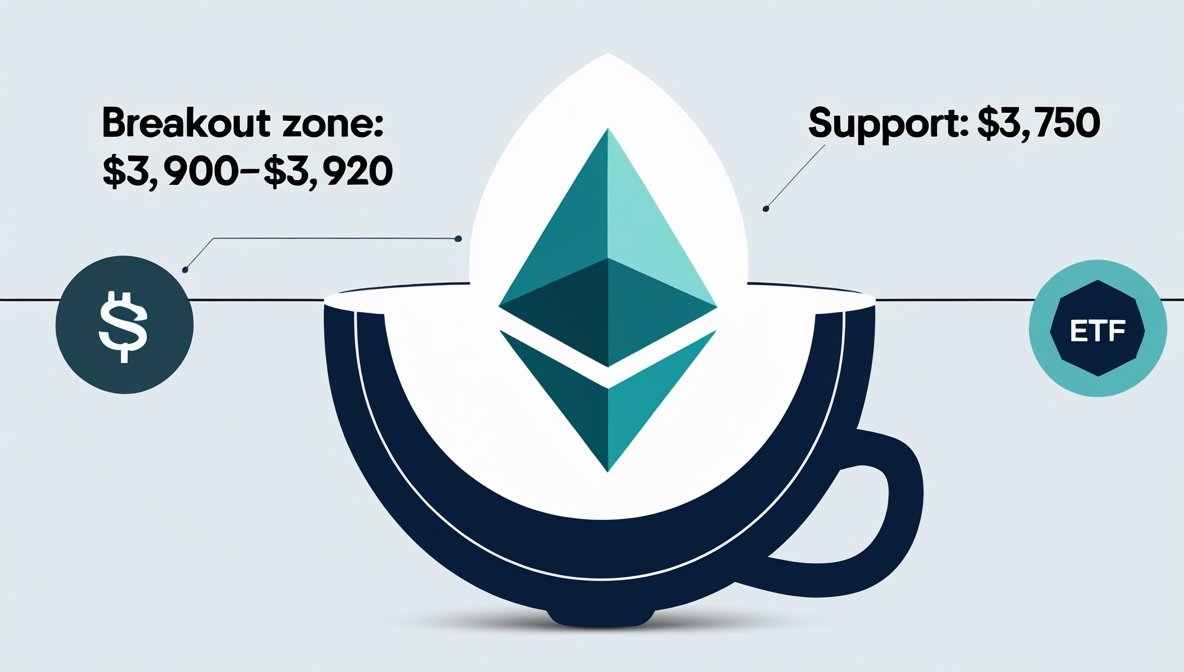
    Ethereum’s chart is displaying a classic cup-and-handle pattern, with the “handle” forming near $3,900. A breakout above $3,900–$3,920—especially with volume—could propel ETH toward $4,200.
  4. Macro & DeFi Environment
    DeFi activity on Ethereum is ticking higher, with aggregate TVL rising ~5% this week. At the same time, easing macro volatility and expectations of dovish central banks are improving risk appetite.

Quick Take:
This ethereum price analysis outlines a setup primed for upside: ETF optimism, rising staking, bullish chart structure, and supportive fundamentals. Watch the $3,900–$3,920 breakout zone—if ETH clears it with volume, a run to $4,000+ could follow. Failure to hold above $3,750 might lead to a test of $3,650 support.

YOU MIGHT ALSO LIKE: Fake Coinbase Crypto Surges 235% in 24H, Sparks Market Chaos
Insane ! Bitcoin Price Analysis: 4 Precision Signals Heralding a Move Toward $115K

Our latest Bitcoin price analysis weighs four key signals that could determine whether BTC stages a rally to $115K or holds its current level around $108K. Here’s the breakdown:

4 Precision Signals in Today’s Bitcoin Price Analysis

  1. Consecutive Spot ETF Inflows
    Major spot Bitcoin ETFs have now recorded 8 straight days of net inflows. Nearly $450 million entered this week alone—indicating growing institutional appetite and removing liquidity from exchanges.
  2. Chart Pattern: Bull Flag on 4H Timeframe
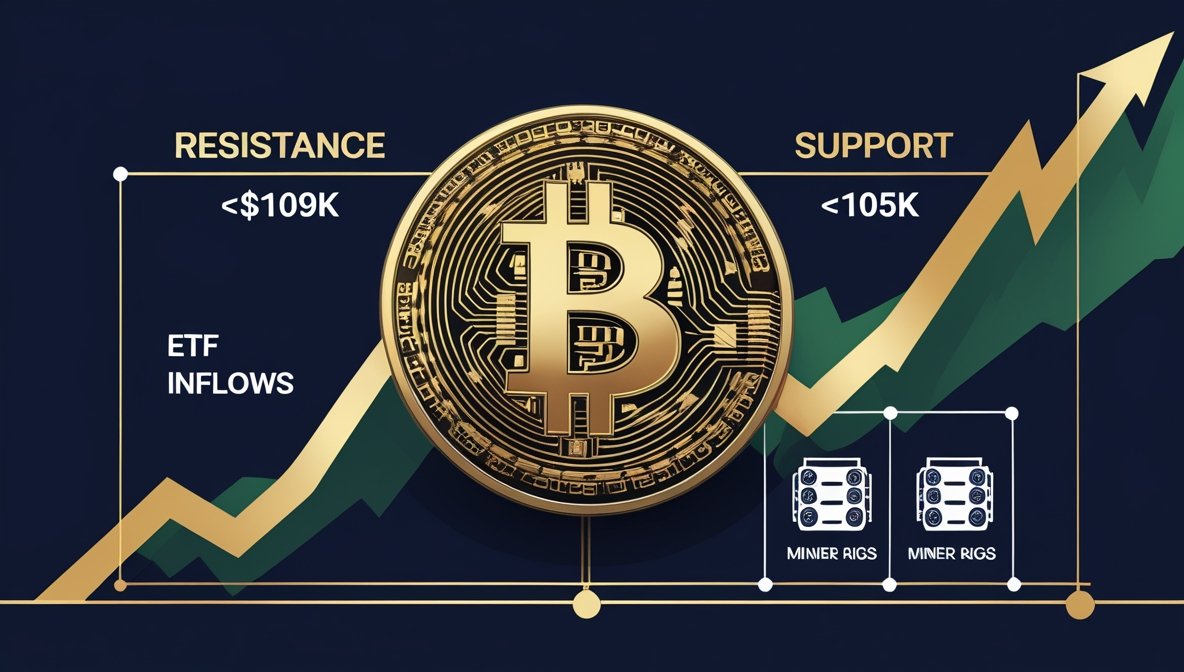
    BTC appears to be forming a classic bull-flag pattern on the 4‑hour chart. A breakout above the flag’s upper trendline (~$109K) with volume could signal a run toward the $112K–$115K zone.
  3. Miners Accumulating, Not Selling
    On-chain mining data shows net miner outflows slowing—many are opting to hold or move BTC into cold storage rather than selling. This supply reduction often precedes bullish phases.
  4. Global Macro Tailwinds
    Risk-on financial sentiment and a dovish Fed outlook are converging. Bitcoin is decoupling from equities and behaving more like a digital asset hedged against macro uncertainty.

Quick Take:
This bitcoin price analysis highlights a bullish setup: strong ETF demand, a brewing bull flag breakthrough, reduced miner selling, and favorable macro conditions. The key catalyst will be a breakout above $109K on strong volume. If confirmed, BTC could test the $115K level next. Conversely, a rejection might lead to consolidation or a dip back to the $105K support area.

YOU MIGHT ALSO LIKE: Fartcoin Falls 8% in Sharpest Daily Drop in Weeks, Market Cap Slips Below $1.1B

Tether Mint Today: Could $1B in USDT Spark the Next Bitcoin Rally?

It has sent ripples across crypto markets. Tether released 1 billion USDT into its treasury wallet on the Tron network early Tuesday. Meanwhile, Bitcoin is hovering near fresh highs—leading traders to ponder whether this mint is a precursor to renewed buying pressure.

4 Key Insights From Tether’s Latest USDT Mint

  1. USDT Sitting in Treasury—Ready to Flow
    All the newly minted USDT currently resides in it’s treasury wallet. Historically, similar large mints have preceded significant injections into exchanges or DeFi platforms—signaling potential market momentum.
  2. Tron Dominates Stablecoin Movements
    Tether’s Tron USDT circulation now exceeds $80 billion, driven by fast transactions and low fees. This on-chain footprint makes Tron a go-to for high-volume stablecoin activity.
  3. Inventory Replenishment vs. Market Signal
    It hasn’t officially commented, but large mints often serve two purposes: preparing liquidity buffers or directly supplying market outlets. Traders are split on whether this is prep work or a buy-side setup.
  4. Bitcoin Eyes Higher Ground
    When It minted $2 billion back in May, Bitcoin surged past $111,000 before settling. With BTC again pressing new highs, many market participants believe this $1 billion mint could cue a similar move—if the funds are deployed onto exchanges.

YOU MIGHT ALSO LIKE: Kraken and Backed Expand Tokenized xStocks to BNB Chain

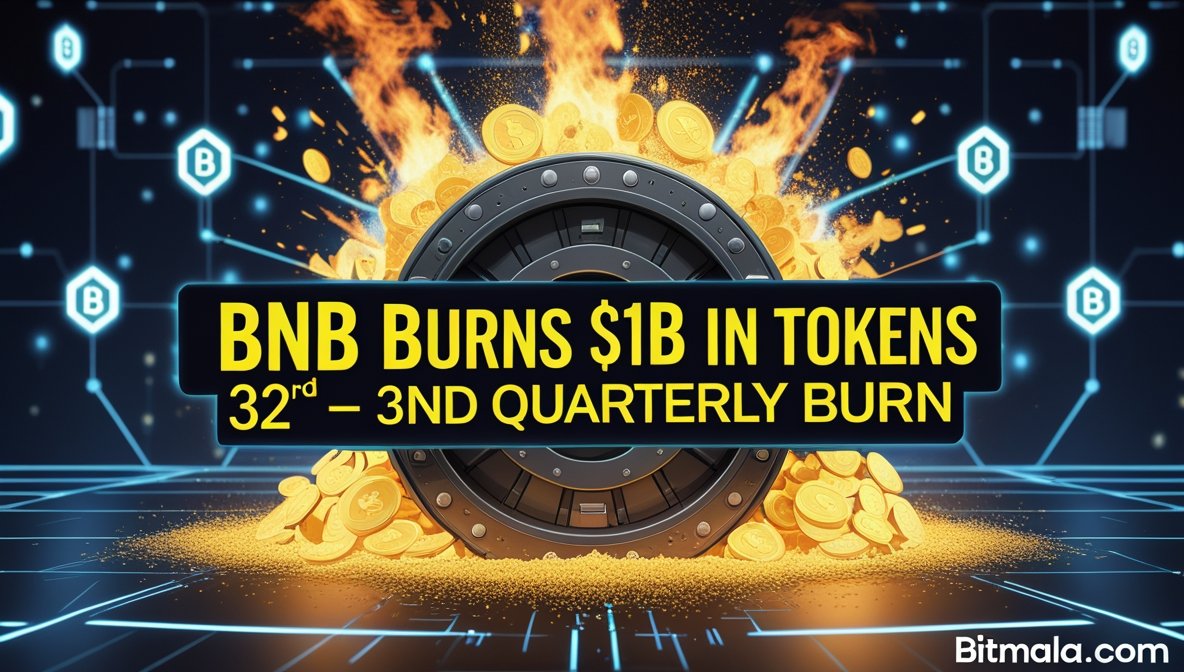
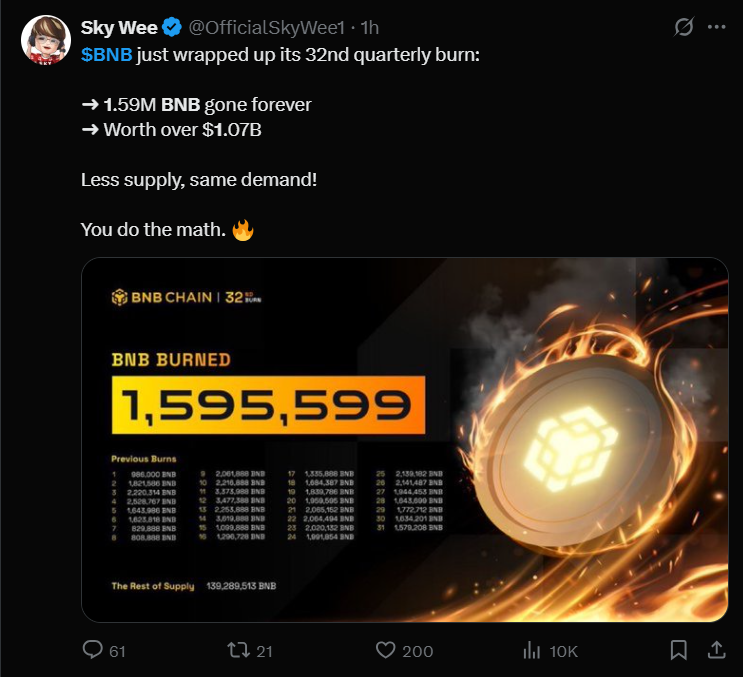
BNB Burns Over $1 Billion in Tokens in Its 32nd Quarterly Burn – What It Means for Investors

The BNB Foundation has successfully executed its 32nd quarterly token burn, permanently removing more than 1.59 million BNB tokens—valued at approximately $1.02 billion—from circulation. Conducted on the Smart Chain (BSC), the burn involved both the platform’s Auto-Burn feature and the Pioneer Burn Program, as per the official statement released by Chain.

BNB

The Auto-Burn system is a supply-control mechanism that eliminates excess tokens each quarter by sending them to an irreversible “blackhole” address. This method supports long-term ecosystem health by increasing token scarcity, stabilizing price movements, and aligning with its roadmap of eventually reducing the total supply to 100 million token.

“The latest burn involved 1,595,470.69 BNB via Auto-Burn and 129.10 through Pioneer Burn,” the announcement noted.

At the time of the burn, it was trading around $670, with a daily trading volume of $1.77 billion and a market cap exceeding $93.5 billion. The deflationary action adds confidence to its value proposition as a key asset powering BSC, opBNB Layer 2, and Greenfield blockchain.

Recent upgrades like Lorentz and Maxwell have improved block production speeds, necessitating a slight adjustment in the Auto-Burn formula to reflect the enhanced chain efficiency.

New Horizons: BNB Treasury Company Eyes U.S. Stock Listing

In a parallel development, YZi Labs—a venture backed by Binance founder CZ—announced its support for the Treasury Company, which plans to go public in the United States. This move could give traditional investors regulated access to the ecosystem, potentially increasing its visibility and adoption.

You might also like: Kraken and Backed Expand Tokenized xStocks to BNB Chain

Fartcoin Falls 8% in Sharpest Daily Drop in Weeks, Market Cap Slips Below $1.1B

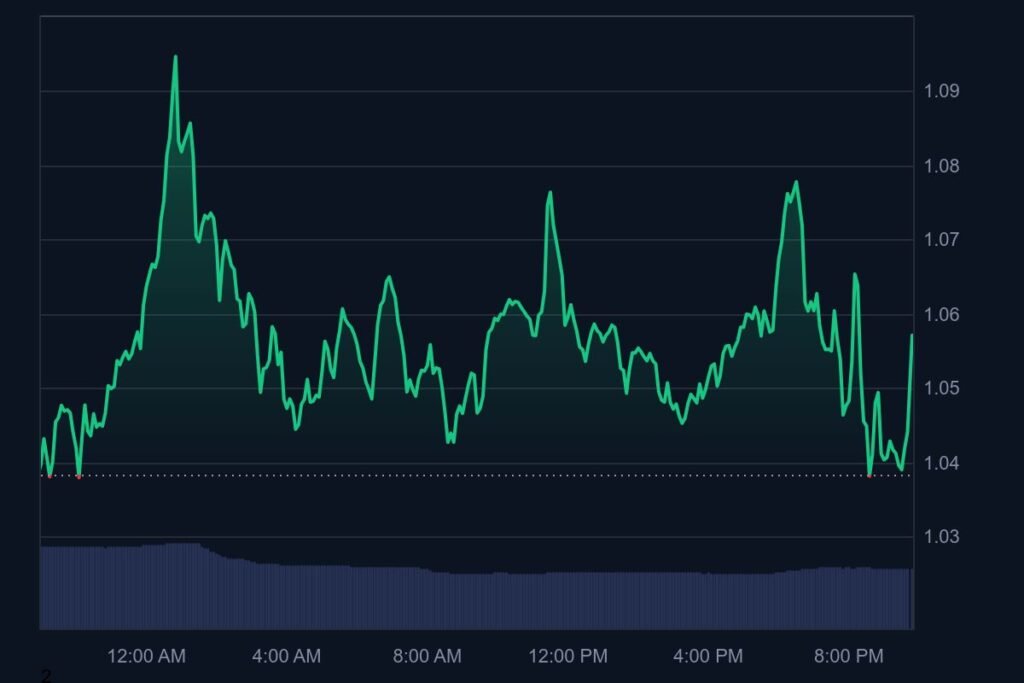
Fartcoin, the meme coin with a cult-like following, saw a sharp decline of over 8% in the past 24 hours, slipping to $1.09 on Tuesday afternoon. This marks its steepest single-day decline in nearly three weeks, erasing roughly $100 million from its total market capitalization and casting doubt on its year-long upward trajectory.

fartcoin

The dip in Fartcoin’s price comes in tandem with a broader cooldown across the crypto market, as Bitcoin and other large-cap assets experience a mild pullback. Now down nearly 28% from its late-June high of $1.51, Fartcoin finds itself flirting with psychological support at the $1.00 mark—a level that could dictate the token’s short-term direction.

According to CoinMarketCap, daily trading volume sits at approximately $238 million, consistent with last week’s average, while CoinGecko data shows an 8.9% slide. With 999.9 million tokens in circulation, Fartcoin’s live market cap stands at $1.09 billion, placing it as the 64th-largest cryptocurrency by market size.

Market sentiment is turning cautious. Chart analysts point to a descending trend line—first established in mid-June—that has repeatedly stifled every recovery attempt. “Trading just at the diagonal resistance, best place to trap breakout traders and early shorters,” noted AltCryptoGems in a fresh technical update.

Adding intrigue, on-chain data from Lookonchain revealed two wallets collectively spent $8.7 million in USDC to buy 7.2 million FARTCOIN on July 6, at an average price of $1.21. This may indicate that some large holders view the pullback as a buying opportunity.

Meanwhile, the Fartcoin development team confirmed that its long-awaited staking portal is set to enter public testing later this quarter. If successful, the move could reduce circulating supply and add new use cases for holders willing to lock tokens for passive income.

Still, derivatives markets are showing restraint. Open interest in perpetual futures has dropped by 12% since Friday, while funding rates on the largest trading pair remain flat, suggesting traders are taking a wait-and-see approach.

If Fartcoin loses the $1.00 support, technicians see the June swing low at $0.87 as the next key level. However, if price holds above $1.00, it keeps the medium-term trend intact—and any future exchange-listing news could reignite bullish momentum.

You might also like: Robinhood Stock Surges 26% on Crypto Push, Faces EU Scrutiny

Kraken and Backed Expand Tokenized xStocks to BNB Chain

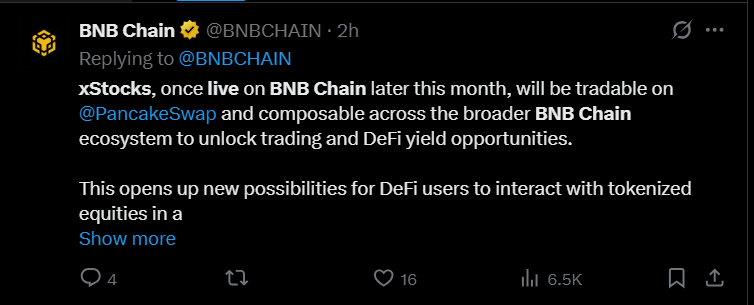
Kraken, one of the leading cryptocurrency exchanges, is teaming up with tokenization platform Backed to bring xStocks—tokenized versions of popular U.S. equities—to the BNB Chain. This integration is expected to significantly broaden the reach of tokenized stocks, allowing global users to access familiar U.S. assets like Apple (AAPLx), Tesla (TSLAx), Nvidia (NVDAx), and the S&P 500 ETF (SPYx) as BEP-20 tokens.

xStocks

According to the official announcement, Kraken users will soon be able to deposit and withdraw xStocks on BNB Chain in the coming weeks, enabling seamless cross-chain movement of tokenized equities.

The decision to expand to BNB Chain—a blockchain network with over $10 billion in total value locked (TVL) and a vibrant Web3 ecosystem—comes down to scalability, speed, and affordability. BNB Chain’s low gas fees and high throughput make it an ideal network for widespread adoption of digital assets.

“The future of markets is multichain,” said Kraken’s co-CEO Arjun Sethi. “Tokenized equities like xStocks aren’t just digital representations—they’re components of a new financial framework that enables borderless, real-time settlement and integration with decentralized finance (DeFi) applications.”

Adam Levi, co-founder of Backed, emphasized that xStocks are designed to be neutral, public goods accessible to everyone—not locked behind traditional brokerage systems.

“We want xStocks to become what stablecoins are to fiat: liquid, usable, programmable assets that bridge TradFi and DeFi,” Levi noted.

This move aligns with BNB Chain’s broader goal of connecting traditional financial markets with decentralized protocols. Sarah S, Head of Business Development at BNB Chain, said, “Our partnership with Kraken and Backed reinforces our mission to bring high-quality financial products on-chain and empower users with open access to markets.”

The BNB Chain launch comes on the heels of Kraken’s earlier success with tokenized equities on the Solana blockchain, where it listed over 60 U.S. stocks. Bybit also recently integrated xStocks, bringing 10 tokenized equities to its own trading platform.

With cross-chain compatibility, major partnerships, and institutional backing, xStocks are poised to transform how global users interact with traditional equities—making them as agile and accessible as crypto assets.

You might also like: Ripple’s RLUSD Stablecoin Enables 24/7 Cross-Margin Trading via Hidden Road

Ripple Partners With BNY Mellon to Custody RLUSD as Stablecoin Surpasses $500M Market Cap

Ripple just bagged a major ally in its mission to make RLUSD the go-to stablecoin for institutions—none other than Wall Street giant BNY Mellon. In a July 9 announcement, Ripple confirmed that BNY Mellon will act as the primary reserves custodian for RLUSD, a stablecoin tailored for enterprise-grade financial use cases.

RLUSD

This announcement comes as RLUSD hits a $500 million market cap—a clear signal that institutional interest is ramping up.

BNY Mellon, with more than $43 trillion in traditional assets under custody, brings heavyweight credibility and infrastructure to the table. The bank will also provide Ripple with access to its powerful transaction banking services to help streamline global payment operations.

Ripple’s SVP of Stablecoins, Jack McDonald, said RLUSD fills a critical void for institutions seeking a stable, transparent digital dollar alternative.

Adding a little intrigue to the mix: Sandie O’Connor, who sits on both Ripple’s and BNY Mellon’s boards, provides a direct governance connection between the two financial titans.

Ripple has been aggressively scaling RLUSD’s ecosystem. It recently partnered with Swiss crypto bank AMINA and OpenPayd to offer custody, trading, minting, and burning of RLUSD. The company has also applied for a national bank charter from the OCC—showing that Ripple’s ambitions aren’t stopping with just stablecoins.

After the BNY news, XRP saw a solid price jump, trading at $2.38—up nearly 4% in 24 hours.

You might also like: Toncoin Surges on UAE Residency Hype—Then Crashes After Official Denial

Fake Coinbase Crypto Surges 235% in 24H, Sparks Market Chaos
‘Coinbase’ Altcoin Soars 235%, But It’s Not the Real Deal

A newly launched crypto token named “Coinbase (COIN)” has sent shockwaves through the market after surging over 235% in just 24 hours—despite having no connection to the real Coinbase Global Inc. (NASDAQ: COIN).

coinbase

The altcoin, which appears to mimic the branding of the popular U.S. crypto exchange, has rapidly climbed to a market cap of $23 million. Since its launch, the token has delivered a jaw-dropping 2,800% return, raising both eyebrows and regulatory concerns across the crypto community.

Meanwhile, actual Coinbase stock has remained relatively stable, gaining just 0.57% on the day. It opened at $354.20 and currently trades around $357.84, reflecting cautious investor sentiment despite recent bullish analyst upgrades.

Analysts like Gautam Chhugani from Bernstein recently raised Coinbase Global’s price target from $310 to $510, citing its S&P 500 inclusion, Ethereum Layer-2 innovation, and growing dominance in the U.S. crypto exchange market.

Important clarification: The Coinbase (COIN) token is not affiliated with Coinbase Global in any way. This is explicitly stated on CoinMarketCap, but that hasn’t stopped many traders from confusing the two—especially with the misleading name and ticker symbol.

The episode adds to the growing trend of lookalike tokens trying to ride the wave of established crypto brands. Experts warn retail investors to always double-check project legitimacy before jumping in, especially during volatile surges.

In short, the “Coinbase” altcoin may be pumping now—but it’s no substitute for the real deal. As FOMO spikes, so does the risk of being caught on the wrong side of a speculative play.

You might also like: Bybit Launches Crypto Platform in Georgia with Full Local License

Robinhood Stock Surges 26% on Crypto Push, Faces EU Scrutiny

Robinhood Rallies 26% on Tokenized Stock Launch, Faces EU Backlash

Robinhood Markets ($HOOD) soared nearly 26% over the past month, propelled by bold moves into blockchain-based tokenized equities and crypto infrastructure.

ROBINHOOD

The company recently unveiled a new platform in the European Union that allows users to trade over 200 tokenized U.S. equities and ETFs. Built on Arbitrum, these products offer synthetic exposure—not ownership rights—to major public and private firms, including OpenAI and SpaceX.

While the move has excited crypto-native investors and pushed Robinhood stock as high as $95, regulators in the EU have raised red flags. The Bank of Lithuania is now investigating the legality and disclosure standards of Robinhood’s tokenized offerings. OpenAI also distanced itself from the tokens, warning investors of potential misinformation. Elon Musk added fuel to the fire by publicly calling OpenAI’s equity “fake.”

The company insists the tokens are merely derivatives tracking market prices and aren’t tied to real equity. Still, critics argue that retail investors may be misled by unclear language and a lack of investor protections—especially given the tokens’ unregistered nature and lack of governance rights.

On the business side, Robinhood’s aggressive crypto expansion continues. It finalized its acquisition of Bitstamp, gaining access to over 50 global licenses. This positions Robinhood to offer institutional services like staking, lending, and high-volume trading tools.

Robinhood’s financials show impressive growth: revenue jumped 60% to $3.3 billion in the past year, with quarterly growth at 50%. Its operating income reached $1.3 billion, and the net margin sits at a strong 48.8%.

However, some analysts remain cautious. With a lofty price-to-sales ratio of 24.1 and P/E of 49.5—both far above market averages—Robinhood’s stock could be vulnerable if sentiment shifts.

Nonetheless, its hybrid model of traditional trading and blockchain innovation is attracting both investors and institutions bullish on the future of tokenized finance.

You might also like: Ripple’s RLUSD Stablecoin Enables 24/7 Cross-Margin Trading via Hidden Road

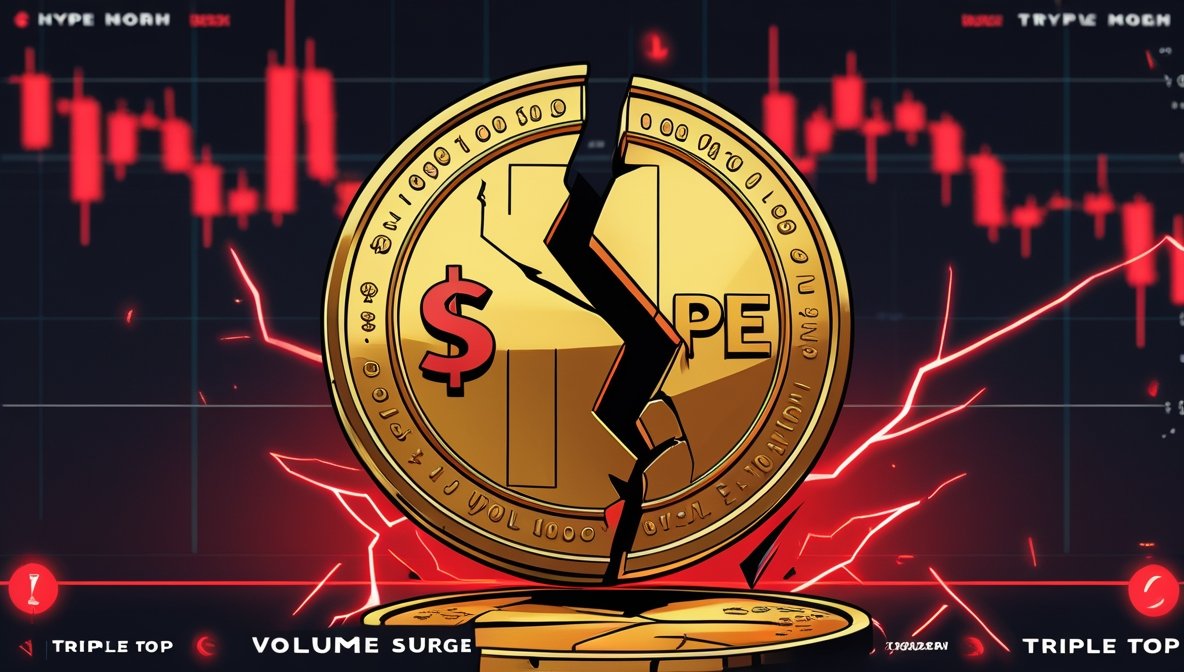
$HYPE Crashes 3.4% as Bears Break $38: Triple Top Confirmed

Hyperliquid ($HYPE) Slips Below $38: Bearish Signal Intensifies

Hyperliquid’s native token, $HYPE, took a sharp 3.4% dip in the last 24 hours, breaking below a crucial $38 support level. This move confirmed a triple-top breakdown, with repeated rejections at the $43 resistance zone now signaling a broader bearish trend.

$hype

Trading activity surged, with volume up by 37% to $270 million. Analysts flagged a significant -14.6K delta in one candle — a clear sign of aggressive sell-side pressure. This coincided with a breakdown from the $37–$43 range, previously seen as a key consolidation zone.

Despite the technical weakness, Hyperliquid remains a dominant force in the DeFi derivatives space. With over $1.57 trillion in annual perpetuals volume and $56 million in June revenue, it outpaces several leading blockchains in fee generation.

Institutional players are taking notice. HYLQ Strategy Corp. acquired over 3,500 $HYPE tokens recently, and Hyperliquid’s recent launch of CoreWriter, a HyperEVM-compatible smart contract layer, signals a new wave of dApp innovation.

Furthermore, integrations like Maple Finance accepting $HYPE as collateral, and Okto Wallet’s native mobile app launch, suggest Hyperliquid is far from slowing down.

Technically, however, the road ahead looks choppy. Unless bulls can reclaim the $40+ territory with conviction, the next support lies around $31–$32, aligning with the measured move from the broken rectangle pattern.

With a solid foundation but clear chart weakness, $HYPE’s next moves could define its short-term market direction.

You might also like: Toncoin Surges on UAE Residency Hype—Then Crashes After Official Denial

Exit mobile version