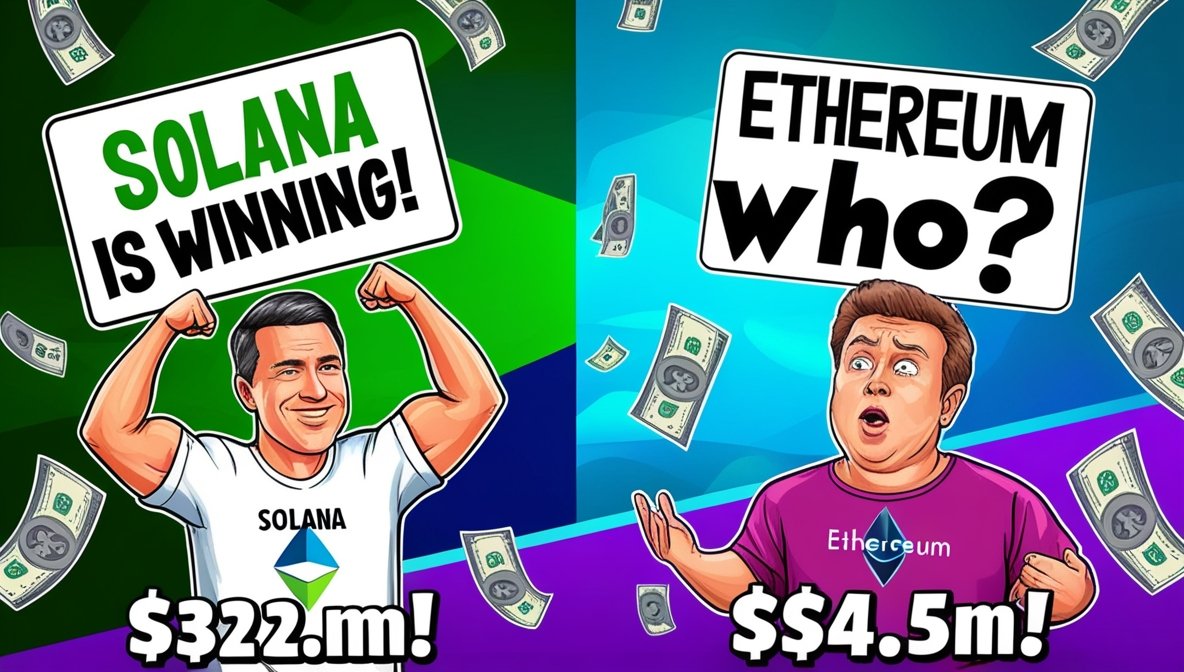
Solana’s Gas Fees Overtake Ethereum’s in the Past Week

Solana’s gas fees hit $32.2M, surpassing Ethereum, driven by rising transactions, memecoin trading, and DEX usage.

Solana has been making big moves lately. Just recently it surpassed Ethereum in gas fees. Nansen CEO Alex Svanevik recently shared that Solana brought in around $32.2 million in fees, while Ethereum made $25.5 million. This shows Solana’s growing popularity and potential to compete with Ethereum.

So, what’s behind this spike? Well, Solana’s been processing more transactions than ever before. It’s becoming pretty much the go-to platform for smart contracts, and more people are using it daily. Memecoins have also created a lot of buzz on platforms like Pump.fun, driving up transaction volume.

Additionally, decentralized exchanges (DEXs) like Raydium are seeing more activity, contributing to the rise in fees. With Solana handling about 718.65 million transactions in just seven days—around 87 times more than Ethereum—it’s clear that Solana is becoming a major player in the blockchain space.

These higher transaction counts are causing more network congestion, leading to occasional transaction failures and higher gas fees. If this trend continues, Solana could challenge Ethereum’s dominance in the blockchain world.

You might want to read: Ripple and MoonPay Donate $50K RLUSD to Support LA Firefighters

Twin Protocol Debuts $TWIN Token on BitMart Exchange

Twin Protocol drops $TWIN on BitMart! Trade globally, create AI Twins, monetize skills, and keep data secure with blockchain.

Twin Protocol is taking its mission to the next level by launching its native token, $TWIN, on the global crypto exchange BitMart. Starting January 13, 2025, users worldwide will be able to trade $TWIN, gaining access to the platform’s unique AI tools designed to create digital replicas of users, known as AI Twins.

In other words, AI Twins are a whole new, innovative way of knowledge sharing, customer service improvement, and monetizing expertise. Special digital versions of users can even model their very own personality traits, skills, and knowledge. It is a very powerful tool for mentoring, customer support, and beyond. One can train an AI Twin as easily as just uploading documents, recordings, or other data. When trained, the AI Twins can be shared publicly or via the soon-to-launch Twin Marketplace, where users can monetize their expertise in the form of $TWIN tokens.

Twin Protocol’s partnership with SingularityNET, a leading decentralized AI platform, ensures that data security and personalization are at the forefront. By leveraging blockchain technology, Twin Protocol gives users full control over their AI identities, making the platform secure and empowering.

This BitMart listing follows $TWIN’s launch on Uniswap in 2024 and marks another step toward making Twin Protocol’s tools widely accessible. With AI expected to drive massive economic changes in the coming years, Twin Protocol is giving individuals and businesses the tools to stay ahead while keeping their data safe.

Also Read: Pro-XRP Advocate John Deaton Pushes SEC to Publish Hinman Documents

MicroStrategy Adds 2,530 BTC, Reaches 450,000 Bitcoin Milestone

MicroStrategy boss Michael Saylor flexed with 2,530 new Bitcoin buys, now holding 450K BTC worth $40.8B, up $12B profit!


Michael Saylor, the Bitcoin boss, just dropped some major crypto news! His company, MicroStrategy, snagged 2,530 more BTC worth $243M between January 6 and 12. That’s a massive boost to their stash, which now stands at a jaw-dropping 450,000 Bitcoin.

Here’s the tea: MicroStrategy scored these coins at an average of $95,972 each. With Bitcoin sitting around $92K now, their total holding is valued at $40.8B, giving them a solid $12B profit on their $28.2B investment.

This move cements MicroStrategy as the biggest Bitcoin whale in the corporate world, afterall it owns about 2.1% of all BTC. They’ve been on a 10-week buying streak, all part of their “21/21 Plan,” aiming to raise $42B through shares and bonds to stack even more BTC.

Oh, and they’re still hustling! They sold 710K shares in January for $243M and have $6.5B worth of shares ready to fund future buys.

While Bitcoin’s price dipped 9% recently to $90.5K, Saylor’s faith hasn’t wavered. People think upcoming events, like Trump’s inauguration, might give crypto the boost it needs.

Also Read: Ripple and MoonPay Donate $50K RLUSD to Support LA Firefighters

Pro-XRP Advocate John Deaton Pushes SEC to Publish Hinman Documents

John Deaton gives SEC 10 days to release the Hinman report. This urged transparency on XRP and Ripple’s legal drama.


John Deaton, the lawyer repping XRP holders, just dropped a huge ultimatum on the SEC. In a recent live video, he told SEC Chairman Gary Gensler to release the controversial Hinman report within 10 days. Why the rush? The report includes the infamous 2018 speech from former SEC official William Hinman, where he said Ethereum wasn’t a security. This speech is a big deal for XRP holders, and Deaton believes releasing the report would clear up some major questions and help both sides move forward.

Deaton’s call for transparency isn’t coming out of nowhere. Empower Oversight, a watchdog group, has been pushing for an investigation into possible conflicts of interest tied to Hinman’s speech. The investigation wrapped up, and the results were sent to Gensler—but the public still hasn’t seen them. Deaton’s frustrated with the delay, saying the report is key to understanding the SEC’s stance on Ripple and the broader crypto market.

He’s not just asking the SEC to release the info—he’s urging XRP holders to apply pressure by contacting the SEC. Deaton believes public pressure could push the government to act and finally shed light on the Hinman report. This could really have a major impact on the Ripple case.

Read Similar Article: Ripple vs. SEC: Court Grants Request to Seal Critical Documents

Pi Network Urges Community to Gear Up for Mainnet Launch

Pi Network’s Q1 this year mainnet launch is coming! Pioneers: finish KYC, migrate, onboard dApps, and hype Pi payments globally!


Pi Network’s mainnet launch is finally happening, and the hype is real! The Pi Core Team is gearing up for the big moment, expected in Q1 2025, and they’re calling on Pioneers to lock in their contributions for a smooth launch.

In their latest post, the team reminded everyone about the January 31 deadline for KYC verification. If you’re in the Pi fam, make sure you’ve completed all the steps to migrate your account. Got a squad? Make sure your downlines are sorted too—it’s a team effort!

For businesses, now’s the time to level up. The Pi team is urging merchants to explore ways to accept Pi as payment in both physical stores and online platforms. With over 20 dApps already approved for the mainnet, it’s about to be lit for developers. If you’re building, finalize your work and get ready to deploy.

Over 9 million Pioneers have already made the jump to the mainnet, and the numbers are climbing fast. Communities like Pi GCV are taking things next-level by hosting events across India and beyond.

It’s official—Pi Network is going global. If you’re not hyped yet, you’re missing out!

Also Read: Meta Pressured to Incorporate Bitcoin into $72B Treasury Holdings

Meta Pressured to Incorporate Bitcoin into $72B Treasury Holdings

Ethan Peck urges Meta to invest part of its $72B reserve in Bitcoin as a hedge against inflation and devaluation.


Ethan Peck, repping the National Center for Public Policy Research (NCPPR), just hit Meta with a bold Bitcoin proposal. He’s asking the tech giant to drop a slice of its $72B cash reserve into Bitcoin. Why? Peck says Bitcoin’s the ultimate flex against inflation and weak currencies, and it’s about time Meta stepped up.

This isn’t NCPPR’s first rodeo. Back in December of last year, they pitched the same Bitcoin idea to Microsoft, pushing the narrative that BTC is a boss-level hedge. They even slid into Amazon’s DMs, asking for 5% of its assets to go crypto—though let’s be real, Amazon’s probably ghosting that.

Peck’s hyping Bitcoin’s 2024 glow-up—it’s up 124%—while bonds are snoozing with weak gains. He thinks Meta’s got the guts to move beyond boring, old-school money moves. And hey, MicroStrategy’s crushing it with BTC, seeing its stock skyrocket 2,191% over five years. If Meta takes the leap, it could lowkey unlock some major shareholder wins.

Meta’s been a trendsetter in tech forever, so NCPPR’s saying, “Why not be the first major player to adopt Bitcoin in your treasury?” With inflation biting and Bitcoin booming, it’s Meta’s moment to shake up the game—or miss out.

Also Read: Heritage Distilling and Five Other Companies Embracing Bitcoin

Whitehat Hacker Recovers $1.5M in DeFi’s First Major 2025 Breach

Hackers stole $2.5M from DeFi platform Moby, but whitehat Tony Ke recovered $1.5M using the hacker’s own mistake.


This year’s first big crypto hack really packed a punch when hackers siphoned off $2.5 million from Moby, a DeFi options platform on the Arbitrum network. A hacker was able to exploit a proxy contract with a leaked private key and managed to enable an emergency withdrawal function that grabbed assets such as 207 WETH and 3.7 WBTC. But wait-this story gets wild.

Enter Tony Ke, a self-proclaimed “noob engineer” and MEV researcher at Solayer Labs/Fuzzland, who swooped in like a crypto superhero. Ke’s MEV bot spotted a loophole in the hacker’s contract, which the attacker left unsecured after exploiting Moby’s private key. Ke seized the opportunity, executing a counter-hack to recover $1.5 million in USDC from the thief’s contract.

The remaining $1 million in WETH and WBTC is still out there, but Moby has vowed to cover all the losses and make things right for their users.

While this drama unfolded, another crypto mishap occurred: Virtuals Protocol’s Discord server was breached after a mod’s private key was leaked, allowing hackers to spread phishing links. Fortunately, Virtuals patched things up.

The Moby hack shows how fast things can turn in crypto—high-stakes drama, whitehat heroes, and the race to recover stolen funds.

Also Read: U.S. Government Conducts Test Transfer of Silk Road Bitcoin

Ripple vs. SEC: Court Grants Request to Seal Critical Documents

Ripple scored a win after the judge approved sealing key docs in its SEC battle. XRP price rose slightly amid appeal prep.


The Ripple-SEC saga just took yet another dramatic turn, as Judge Phyllis J. Hamilton granted the seal of some pivotal court documents. This move has been in the pipeline, pushed by Ripple CEO Brad Garlinghouse and the SEC, in a bid to keep sensitive information close to their chests as the case heats up for appeals. Sealed documents will include exhibits tied to summary judgments and expert testimonies.

Both Ripple and the SEC made solid arguments under the Ninth Circuit’s “compelling reasons” rule, which balances privacy with public access. Ripple asked to seal eight exhibits related to their wins and 56 opposing the SEC’s motions. Plus, the SEC wanted parts of its expert testimony hidden. The judge called it fair, especially with the stakes so high.

Ripple snagging this small victory keeps the momentum on their side. Remember when Ripple won the major ruling that XRP isn’t inherently a security? That was a huge L for the SEC. But the SEC isn’t backing down, with a big appeal in the works that could reshape crypto regulation.

XRP prices climbed 1.7% and hit $2.31, plus analysts are also predicting more movement soon. And those wild rumors about Trump meeting Garlinghouse? If true, it might flip the script in Ripple’s favor. Stay tuned—this case is a game-changer for crypto.

Also Read: Thailand Police Bust Bitcoin Mining Operation Stealing Millions in Power

U.S. Government Conducts Test Transfer of Silk Road Bitcoin

The U.S. government tested moving seized Silk Road Bitcoin (0.00000546 BTC) ahead of selling 69,000 BTC worth $6.5B.


The U.S. government just made a tiny Bitcoin move from the FBI-controlled wallet holding Silk Road’s seized stash. On January 10 of this year, a small test transaction of 0.00000546 BTC (around $0.51) popped up on the blockchain, hinting at prep work for bigger moves. It’s basically the government dipping its toes in the water to ensure smooth transfers later.

This wallet isn’t just any wallet—it’s a treasure chest of about 69,000 Bitcoins, valued at a jaw-dropping $6.5 billion. These were confiscated from someone who snagged them from the infamous Silk Road marketplace, a dark web hub for illegal deals back in the day.

Why does this matter? Well, the FBI has the green light to offload these coins. And this test suggests the big sell-off could be just around the corner. When such a massive amount of Bitcoin enters the market, it’s bound to stir things up, potentially shaking Bitcoin’s price.

For now, though, the move is more about logistics than market impact. But keep an eye out—when Uncle Sam starts cashing out billions in Bitcoin, it’s going to be a headline-grabber. For the crypto space, this is a major flex and a moment to watch.

Also Read: 70-Year-Old Woman Loses Crypto Fortune in LA Wildfire

User Faces $208k Fee for Solana Transaction Shocker

A Solana user paid a wild $208k fee by mistake, showing how blockchain errors can cost big time. Double-check, folks!


A Solana user recently paid a jaw-dropping $208,692 fee (1,068 SOL) for a transfer of just $95k worth of assets. Ouch! The transaction took place on 8th of jan this year, where 495.5 SOL (around $94,837) was sent from one wallet to another. But the kicker? The transaction fee was a whopping 1,068 SOL, with most of it being a priority fee.

Solana’s best known for its low fees, usually around $0.00025 per transaction. This means its definitely an outlier. The massive fee likely happened because the user selected an insanely high priority fee, thinking it would speed up the process. But with Solana’s high throughput, most transactions get confirmed fast without that extra push.

This isn’t the first time we’ve seen crazy blockchain fee mistakes. About a decade ago, a Bitcoin user accidentally paid 291 BTC (about $137k at the time), and in the pandemic era, an Ethereum transaction had a 10,668 ETH fee ($2.6 million).

Moral of the story: always double-check your transaction details! Blockchain transactions are irreversible, and mistakes can be expensive. This incident shows why user education and smarter transaction systems are a must for the crypto world. Stay safe out there!

You might like: Zypto Integrates Pi Network Wallet for Enhanced User Experience

Exit mobile version