Ethereum Bags $321M Inflows—But Still Can’t Crack $2.5K?
Ethereum is seeing big money roll in—$321 million last week, its highest since December 2024. That’s six straight weeks of gains, adding up to $1.19B in institutional love. So, why is the price still stuck at $2,482?
Let’s break it down:
On-Chain Vibes:
ETH is locked between $2,475 and $2,555—no breakout yet.
RSI is at 36.23 = almost oversold.
MACD is still red (-3.66), signaling weak momentum.
Zoom in to the 1-minute chart and it’s just as boring. ETH is chopping around $2,483 with no conviction. Short-term MACD flipped green (0.61), but nothing major.
ETH needs to break back above $2,500–$2,520 to wake up the bulls. If it slips under $2,475, things could head south toward $2,400 fast.
Meanwhile, digital asset funds pulled in $286M total last week. But Bitcoin broke its 6-week inflow streak, and XRP got smacked with $28.2M in outflows. Even BlackRock’s IBIT saw a record $430.8M exit in one day.
Big money’s still eyeing ETH—but if the charts don’t shape up soon, this could be a bull trap in disguise.
Bitcoin Eyes $340K? Analyst Says It’s Now or Never for BTC Rebound
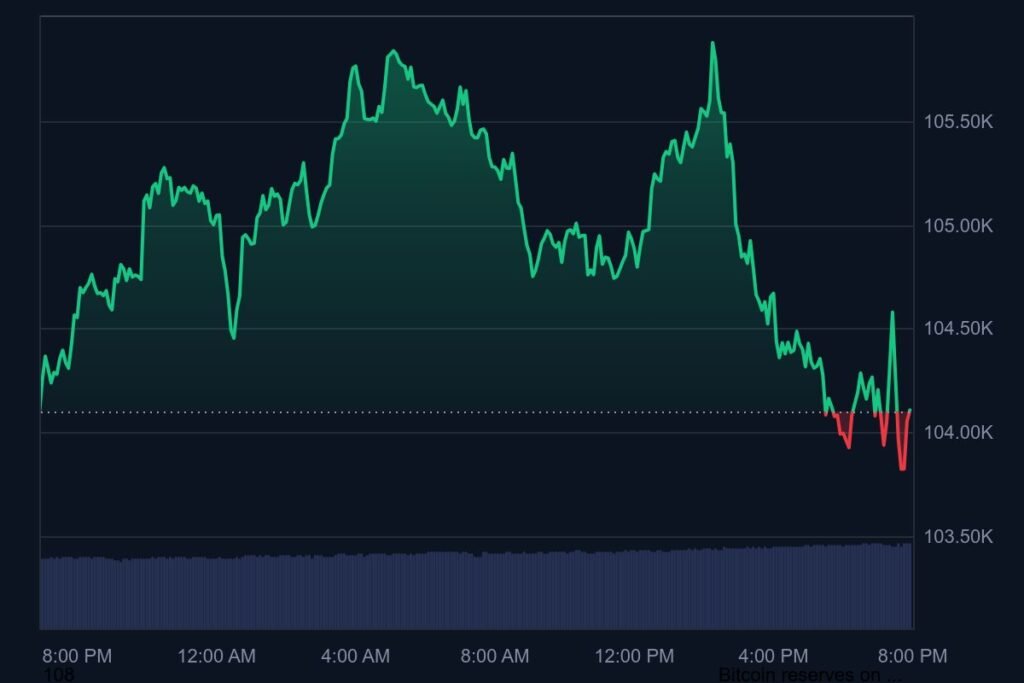
Bitcoin is chilling at $103,993 after a slight 0.18% dip, but don’t count it out just yet. Crypto analyst PlanD sees massive upside—$340K levels—if BTC holds its ground in the $91K-$100K support zone.
He’s spotting a cup-and-handle formation that’s been building since the 2021 drop to $69K. The “cup” was filled by March 2024, and now the “handle” is forming below $112K.
Technical Breakdown:
BTC is in a descending channel—a classic consolidation phase.
Resistance sits at $105,292 (50 EMA), which BTC must crush to see a breakout.
RSI is under 40 (mildly oversold), and the MACD is showing signs of a reversal brewing.
Support levels to monitor: $104,514, $103,149, and $102,141.
🚨 Close above $105,292 with strong candles (engulfing, three white soldiers), and BTC could hit $107K+ fast.
Meanwhile, enter Best Wallet ($BEST)—a crypto wallet going beast mode:
Supports 1,000+ tokens
Built with Fireblocks MPC-CMP tech for A-tier security
Donut Labs Just Scored $7M to Reboot the Browser — Now With Crypto, AI & Vibes
Say bye to your boring old browser. 👋 NYC-based Donut Labs just raised $7 million to build the world’s first AI-powered “agentic” crypto browser — and it’s not playing around.
“We’re reconstructing the front end of the internet,” said founder Chris Zhu. “Think Chrome meets GPT, but with built-in crypto powers.”
💸 Who Threw the Bag?
The pre-seed round was led by HSG, Bitkraft, and HackVC, with angels from the Solana ecosystem, Matrix Partners, Sky9 Ventures, and Makers Fund jumping in too.
They’re all betting big on Donut, a crypto-native browser with:
⚙️ Built-in wallet
🔁 DEX integration
🌐 On-chain access
🤖 AI agents that can execute blockchain ops like a boss
🧠 What Makes Donut Special?
Unlike Chrome or Brave, Donut isn’t just “web3-compatible.” It’s built for AI agents from the ground up.
🧠 AI reads the page, gets your intent, and can make moves (swap tokens, sign contracts, even stake your bags)
🛡️ AI safety checks every action with a “plain English” translation of scary calldata
Brad Just Dragged Bitcoin — XRP to the Moon or Nah?
XRP CEO Brad Garlinghouse did not hold back. At a recent high-level event with reps from the IMF and Swiss National Bank, Brad called out Bitcoin like it owed him money.
“Bitcoin is kinda slow and kinda expensive,” Brad said bluntly, comparing it to it, which he claims is “1,000x faster and cheaper.”
XRP’s Pitch: Kill the Pre-Funding Era
Brad went off about how banks currently hold cash all over the world just to make international payments — a messy system called pre-funding. His take? The token can nuke that whole model by acting as a bridge currency. Basically:
Why wait 3 days to move money when XRP can do it in seconds?
He even said XRP could help “exotic currencies” (aka the ignored underdogs of the FX world) connect to global finance better. Real inclusive vibes.
Vision: Internet of Value > Internet of Just Memes
Brad’s endgame? The token becoming the TCP/IP of money — a tech layer powering the Internet of Value, where payments fly like DMs.
“$100M or $30 — everyone should be able to move money, fast and cheap,” he said.
Internet Reacts: BTC Maxis vs XRP Army
A video clip hit X (formerly Twitter) and the crypto fam had thoughts.
🟠 BTC Stan: “Decentralization > speed. BTC still leads in trust & adoption. XRP ain’t it.”
🔵 Its Defender: “LMAO. Who’s buying BTC for cross-border payments? IT actually works. Stop coping.”
Troll Watch: “Brad still handing out free XRP? Bro’s trying too hard.”
TL;DR — No Cap Breakdown:
Crypto Twitter is having a full-on meltdown
Brad Garlinghouse 🔥 roasted Bitcoin at a big-time event
Claims the token is 1000x faster & cheaper
Says the token can kill pre-funding and boost forgotten currencies
Vision: make sending money as easy as sending memes
May ended with some serious crypto turbulence. The SEC dropped a cold bucket on the hype train around Ethereum and Solana ETFs, and boom – $SOL dropped 11.45%. Yup, a full-on dip. For 23 days, Solana was vibing between $155 and $185… until the ETF drama hit the fan.
On-Chain Heat Check: Users Still Showing Up
Despite the price slip, SOL’s ecosystem is actually getting more action. New wallet addresses keep climbing –
March: 98.3M
April: 111M
May: 123.8M
That’s major growth and lowkey shows the SOL fam isn’t backing down. Adoption? Still climbing.
Funding Rates & Bearish Feels
Funding rate’s in the red at -0.0027%, which basically means: traders are less bullish and more cautious rn. Not a vibe.
Price Action Breakdown
Down 1% in the last 24h
Red candles for 3 straight days
7-day drop: 11%
Monthly gain? Still +4.93% (So not all bad)
RSI’s sitting at 41.66 – aka almost oversold. Not ultra-bearish, but it’s not sunshine and rainbows either.
What’s Next?
If SOL can hold the line at $150 and the bulls show up, we might see a retest at $177. If hype builds, $200 could be back on the radar – a level we haven’t touched since Feb 2025. 🚀
But if things break bad and liquidations kick in, $127 (April low) is calling… and nobody wants that.
MEXC Reports 200% Rise in Crypto Fraud, Flags Over 80,000 Scam Attempts in Q1 2025
Crypto security might be evolving, but so is crypto fraud — and it’s exploding. On May 30, crypto exchange MEXC revealed that detected fraudulent activity on its platform soared by 200% year over year, fueled largely by market manipulation, bot trading, and wash trading attempts.
In Q1 2025 alone, MEXC flagged 80,057 fraud attempts, more than doubling from the same period in 2024. The fraudulent behavior came from over 3,000 coordinated syndicates, using increasingly advanced tactics to exploit new users in volatile markets.
India took the top spot as the global hotspot for crypto fraud, with nearly 27,000 accounts flagged — a 17% year-over-year rise. Indonesia followed with a staggering 5,603 flagged accounts, marking a 1,303% increase, underscoring how rapidly fraud is evolving in Southeast Asia.
The Commonwealth of Independent States (CIS) region also saw a 245% rise in flagged activity, with 6,404 accounts tied to suspicious or manipulative trading behavior.
MEXC’s Chief Operating Officer, Tracy Jin, attributed this rise in fraud to a troubling mix of:
Low financial literacy in fast-growing crypto markets,
The spread of fake influencer accounts, and
The rise of misleading “educational” trading groups used to push scam tokens and exit liquidity schemes.
“We’ve observed a growing number of so-called ‘educational’ trading groups that appear to be coordinated efforts to mislead users,” said Jin. “This highlights the importance of user education, especially for young and first-time investors.”
MEXC emphasized that these scams often rely on social engineering — exploiting trust, hype, and fear of missing out (FOMO) to trap users. Some of the most common tactics include pump-and-dump groups, influencer fraud, and fake financial advisory networks posing as legit crypto coaches.
In response, MEXC announced plans to launch several user education campaigns aimed at helping users recognize and avoid deceptive schemes. These will include in-app alerts, tutorial videos, and regional partnerships with crypto educators.
The spike in fraud mirrors a larger trend in 2024 and 2025. The FBI previously reported that over $9 billion in crypto-related fraud losses were recorded in 2024 alone, with “pig butchering” scams among the most damaging.
On May 29, 2025, new research by Artemis, Castle Island Ventures, and Dragonfly showcased the rising real-world impact of crypto-powered stablecoins. The comprehensive study collected insights from 20 stablecoin firms and 11 related companies, highlighting a key truth: stablecoins are no longer a niche — they’re leading the next wave of crypto adoption.
Once a niche concept, stablecoins are now central to global finance and cross-border transactions. These digital assets fuse the benefits of crypto — speed, accessibility, decentralization — with the stability of traditional currencies like the U.S. dollar.
The study revealed that the total supply of them now sits at $239 billion, held across 150 million wallet addresses. From January 2023 to February 2025, more than $94.2 billion in non-trading stablecoin transactions were processed — underscoring their growing use for real-world payments.
At the May 2025 Bitcoin Conference in Las Vegas, it were the unexpected stars, repeatedly mentioned in talks and memes. And for good reason: they’re now at the center of the U.S. Senate’s ongoing bipartisan efforts to regulate the crypto sector, signaling political recognition of their importance.
The research showed clear market leaders: USDT and USDC, which together account for more than $214 billion in market cap. Networks like Tron and Ethereum dominate blockchain infrastructure for these transactions. Payment giants like Visa, Stripe, and Mastercard are also integrating crypto stablecoin services at scale.
The shift from peer-to-peer (P2P) usage to business-to-business (B2B) transactions became evident in mid-2024. As of February 2025:
B2B payments hit $3B,
P2P stood at $1.5B, and
Card-based stablecoin usage surged to $1.1B.
Interestingly, card-based stablecoin transactions — once minimal — now rival P2P payments, showing deeper consumer integration of crypto into daily life.
The U.S. and Singapore top the global usage charts (18% each), with Hong Kong, Japan, the UK, and Germany trailing. In the U.S. Treasury’s own words, if these coins were a nation, they’d be the 14th largest holder of U.S. debt — highlighting their deep integration with traditional finance.
Ultimately, the study concludes that crypto is no longer theoretical. Stablecoins are actively used by millions to send money, run businesses, and power global commerce — and their role is only accelerating.
The U.S. Treasury Department has cracked down on a major international crypto fraud operation, sanctioning Funnull Technology, a Philippines-based company, and its leader, Liu Lizhi, for facilitating online investment scams.
According to the Office of Foreign Assets Control (OFAC), Funnull played a central role in enabling fake crypto websites that impersonated legitimate investment platforms. These scam sites have reportedly caused over $200 million in global losses.
Funnull’s scheme involved purchasing large pools of IP addresses from tech companies and selling them to criminal networks. These resources allowed fraudsters to build and rotate fake crypto platforms, making it harder for law enforcement to trace their activities.
In 2024, the company escalated its methods by secretly modifying developer tools. The altered code redirected users from real websites to fraudulent crypto pages and gambling sites, further blurring the line between legitimate and scam domains.
Liu Lizhi, a Chinese national, has been added to the Specially Designated Nationals (SDN) list, freezing his U.S.-linked assets and banning all U.S. entities from transacting with him or Funnull. Violations could result in legal action.
Additionally, OFAC sanctioned two crypto wallets tied to Funnull. Blockchain analytics firm Chainalysis confirmed the wallets were used to funnel stolen funds and identified Funnull as a core part of the “Triad Nexus”, a massive fraud network tied to over 200,000 scam websites.
This enforcement action highlights a growing push by U.S. authorities to dismantle infrastructure behind crypto scams, aiming to protect investors and increase accountability in the digital finance space.
Rumors are flying across crypto circles that BlackRock may be preparing to launch an XRP ETF. Social media posts claim a massive $9 trillion investment could be coming — but how accurate is this?
BlackRock has made waves with its Bitcoin and Ethereum ETFs, holding over $43 billion combined in those assets. However, XRP doesn’t share the same regulatory clarity. It remains entangled in legal complications with the SEC, making it a difficult fit for a company like it that sticks with well-regulated offerings.
Despite the hype, BlackRock has not filed for an XRP ETF. A prior filing in April 2025 was debunked as fake, and CEO Larry Fink has never acknowledged XRP in public discussions. The $9 trillion figure cited by rumor mills refers to its total assets under management — not a crypto investment.
There is, however, cautious optimism surrounding XRP ETFs more broadly. The SEC is set to make a ruling on Franklin Templeton’s spot XRP ETF by June 17, 2025. Bloomberg ETF analyst Eric Balchunas puts the odds at 65% for approval eventually, and on-chain prediction markets like Polymarket give it an 83% chance by year-end.
The SEC recently held closed-door discussions with BlackRock, Fidelity, and others — prompting speculation that the agency may be warming to altcoin ETFs, including XRP.
ETF Store President Nate Geraci recently commented: “Spot XRP ETF approval is just a matter of time… The largest ETF issuers won’t ignore this forever.”
While the rumors about BlackRock remain unsubstantiated, the conversation around an XRP ETF is heating up — and all eyes are now on the SEC’s next move.
SOL Strategies Inc. is preparing for potential capital raises to support its pivot toward the Solana blockchain. The company has filed a preliminary base shelf prospectus with Canadian securities regulators, allowing it to offer up to $1 billion in various securities — including common shares, warrants, subscription receipts, and debt — should market conditions align in the future.
CEO Leah Wald emphasized the move as a strategic, long-term step: “The filing of a base shelf prospectus supports our growth strategy by providing us with the flexibility to access capital as future opportunities arise in the rapidly evolving Solana ecosystem.”
Although no offerings are currently planned, this filing positions the firm to act quickly when needed. Formerly Cypherpunk Holdings, its Strategies rebranded last year to reflect its new investment focus on Solana-based opportunities, leaving behind its previous Bitcoin-centric approach.
This announcement signals the company’s growing commitment to infrastructure, DeFi, and blockchain innovation potential.